
Formation of Inclusive Competence of Higher Education Students in the Field of Knowledge 01 Education/Pedagogy
Oksana Dmitriieva,Olena Chopik,Svitlana Mykhalska
https://doi.org/10.53656/ped2025-6.02
Kamianets-Podilskyi Ivan Ohiienko National University (Ukraine)
Abstract. The analysis of the problem of forming inclusive competence of future teachers in theory and practical research shows its extreme relevance. It is especially important to develop inclusive competence at the stage of teaching students at a higher education institution to ensure their further effective practical work. The study shows that a significant part of higher education students understands correctly the concept of "inclusive education", but one third of respondents don’t realize who exactly can be recommended to study in an inclusive form. It has been found that most respondents understand the benefits of inclusive education, they express their attitude to it positively, but some respondents found it difficult to demonstrate their attitude to inclusive education for children with special educational needs. It has been determined that more than half of the respondents are aware of their own role in the team of psychological and pedagogical support for children with special educational needs and the need to cooperate with other team members, but a significant number of higher education students were unable to answer this question. The respondents emphasize a conscious attitude to the difficulties that will arise in the process of inclusive education of children with special educational needs, noting that providing appropriate conditions in the educational institution and the availability of personal qualities of teachers will help to overcome these difficulties. It was found that only one third of modern higher education students have a desire to work with children with special educational needs in conditions of inclusive education, while the vast majority of respondents admitted their own unpreparedness to work with children with psychophysical developmental disorders. Prospects for scientific research are the development of pedagogical support for the formation of inclusive competence of higher education students in the field of knowledge 01 Education/Pedagogy, which would provide for the formation of inclusive competence of higher education students - future teachers.
Keywords: inclusive competence, higher education students, teachers, pedagogical conditions, children with special educational needs
[emember_protected for='16-2-18' format_protected_msg='1' custom_msg='Влезте в системата, за да прочетете пълната статия']
Introduction
Significant socio-economic and socio-political changes taking place in modern Ukraine are causing a change in approaches to the functioning of the national education system, including children with special educational needs, one of the priorities of which is the training of qualified specialists in this field, teachers with formed inclusive competence as an integral part of the professional and pedagogical competence of a modern teacher.
Today scientists from different countries have conducted research that reveals the essence of the phenomenon of "inclusive competence of the teacher" and creates the prerequisites for its formation. The works of scientists define the philosophical and theoretical aspects of inclusive education – A-C. Armstrong, D. Armstrong, D. Goodley, K. Runswick-Cole, F. Polat, Kremin, Y. Naida, N. Sofiy, etc.; compare the trends in the development of inclusive education in different countries - K. Goranson, K. Karlsson, R. G. Berlach, D.J. Chambers; a study of the practical aspects of implementing inclusive education in preschool and general secondary education institutions – J. Goodman, T. Lorman, J. Deppeler, D. Harvey, V. Bondar, V. Zasenko, A. Kolupaieva, I. Kuzava, N. Sofii, O. Taranchenko, etc.
The theoretical analysis of the literature has shown the existence of a number of studies aimed at studying the phenomenon of "inclusive competence". For example, S. Nakhod (2020) presents the definition of "inclusive competence" as an integral personal formation that is part of “soft skills” and determines the ability of a teacher to perform professional functions in the process of inclusive education, taking into account the different educational needs of children, ensuring their inclusion in the general education environment and creating conditions for their development and socialization. It is noted that it is necessary to have a valuable attitude of future teachers to inclusive education, a conscious choice of profession, sustainable motivation to learn and a positive attitude to children with special educational needs. O. Voloshyna and N. Dmitrenko (2017) analyzed the foreign experience of training teachers for inclusive education, pointed out the peculiarities of modifying vocational education programs in higher education institutions in the process of inclusive teacher training, revealed the components of inclusive competence in education; characterized the competence approach as a conceptual guideline for the development of modern education within the Bologna Process.
А. Vasyliuk (2022) and I. Kucherak (2022) define inclusive competence as an integrated phenomenon that combines motivational and value-based, cognitive and operational, as well as reflective and evaluative components; I. Kuzava (2024) analyzed the theoretical sources and practical state of studying the essence of the phenomenon of inclusive competence of future special education specialists, developed its components and criteria; N. Fihol (2020) characterizes inclusive competence as a component of the professional competence of a teacher, interprets inclusive competence as the level of knowledge and skills necessary to perform professional functions in an inclusive education environment; Wendelieen Vantieghem (2023) notes that teachers should be aware of the scope of inclusive education and assess their own capabilities to create the educational prerequisites necessary to maximize the learning of different pupils.
Given the relevance of the problem, the purpose of our study was to find out the focus of the educational process of a higher education institution on the formation of inclusive competence of higher education students in the field of knowledge 01 Education/Pedagogy.
Research methods
To achieve this goal, the following methods were used: theoretical analysis of the problem of forming the inclusive competence of teachers; survey among higher education students; interview with them; quantitative and qualitative analysis of the achieved results.
In the course of the theoretical analysis of the research problem, literature sources were studied to define the phenomenon of “inclusive competence”, its components, ways and conditions of its formation, the importance of its formation for modern teachers.
A survey among higher education students of Kamianets-Podilskyi Ivan Ohiienko National University was conducted anonymously with the help of Google forms. The survey included 13 questions. Each question required a mandatory answer. In order to achieve reliable results, we provided various options for answers, including open-ended questions to interpret one's own attitude to solving a particular problem. The research was aimed at studying the following aspects:
– students' understanding of the concept of "inclusive education"
– determining which categories of children, in the opinion of students, can be recommended an inclusive form of education;
– studying the attitude of students to the introduction of inclusive education in general secondary education institutions;
– finding out what, in the opinion of the respondents, are the advantages of introducing inclusive education;
– finding out, which specialists, according to the respondents, they will need to cooperate with in terms of working in an inclusive institution;
– finding out what difficulties the respondents think they may have in working with children with special educational needs in a general secondary education institution;
– finding out what qualities, in the opinion of students, should have teachers working in an inclusive institution;
– finding out what conditions, in the opinion of students, will ensure the successful implementation of inclusive education for children with special educational needs;
– finding out whether students would like to work with children with special educational needs in a general secondary education institution;
– identifying the difficulties of implementing inclusive education, according to the students’ point of view.
Quantitative and qualitative analysis was used to process the results of the study.
Results
The survey involved 81 higher education students of various specialties. It is worth noting that some of the higher education students have already taken the courses “Pedagogy’’. Module “Fundamentals of Correctional Pedagogy” and “Fundamentals of Inclusive Education”, while others have not yet been taught educational components aimed at familiarizing themselves with the peculiarities of organizing inclusive education for students with special educational needs and developing inclusive competence.
Let's analyze the results of our study.
- What is your future specialty after graduation?
- What year of study are you in?
- Are you familiar with the concept of “inclusive education”?
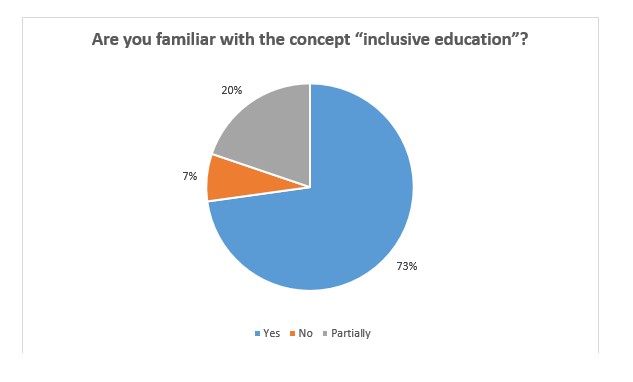
Figure 1
- How do you understand the concept of “inclusive education”?
- What categories of children, in your opinion, can be recommended for inclusive education?
- What is your attitude to the implementation of inclusive education in general secondary education institutions?
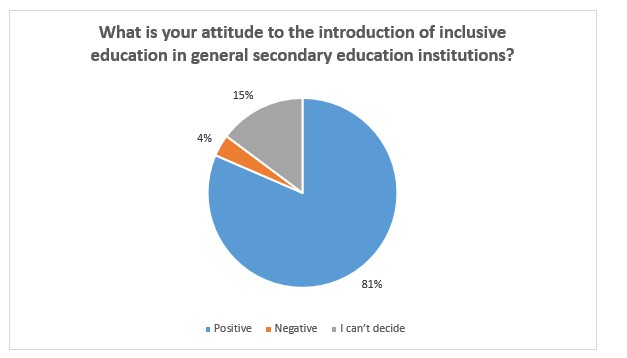
Figure 2
- What are the benefits of implementing inclusive education in your opinion?
- If you work in an inclusive institution, which specialists do you think you will need to work with?
teacher's assistant;
teacher-defectologist;
practical psychologist;
social teacher;
class teacher;
medical worker;
subject teachers;
all answers are correct;
don't know.
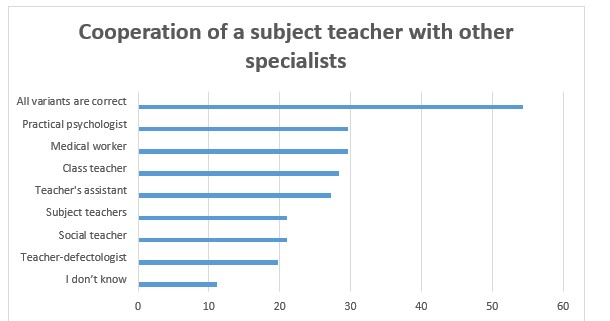
Figure 3
Higher education students answered as follows: with a teacher's assistant (27.2%); with a teacher-defectologist (19.8%); with a practical psychologist (29.6%); with a social teacher (21%); with a class teacher (28.4%); with a medical worker (29.6%); with subject teachers (21%); all answers are correct (54.3%); don't know (11.1%).- What difficulties do you think you may have while working with children with special educational needs in a general secondary education institution?
- What are the difficulties of implementing inclusive education in your opinion?
- What qualities should have teachers working in an inclusive institution in your opinion?
- What conditions will ensure the successful implementation of inclusive education for children with special educational needs?
– individualized approach to teaching and support for each student;
– availability of qualified teachers and specialists who provide support and consult pupils and teachers;
– availability of adaptive materials and technologies for learning;
– promoting cooperation between teachers, specialists, parents and pupils;
– creating a friendly and tolerant classroom environment;
– ensuring physical accessibility of the learning environment for all students;
– constant support and training of teachers on methods and strategies for working with different types of educational needs;
– partnership with parents and guardians;
– good funding for inclusive institutions;
– creating a comfortable atmosphere in the institution where all children feel equal.
- Would you like to work with children with special educational needs in a general secondary education institution? Please explain your answer.
Conclusions and prospects for further research
The analysis of theoretical sources on the problem of forming the inclusive competence of higher education students and practical research have demonstrated the extreme relevance of this problem. Extremely important is becoming the formation of inclusive competence of higher education students during their studies at a higher education institution, after which they will face the challenges of inclusive education of children with special educational needs in their own professional activities.
The results of the study show that the vast majority of higher education students are familiar with the concept of “inclusive education” and correctly understand its essence, but one third of respondents don’t quite understand which categories of people with special educational needs can be recommended an inclusive form of education. In general, most students have a positive attitude toward inclusive education and understand its benefits, but a fifth part of the respondents haven’t decided yet on their position. More than half of the respondents understand their role in the team of psychological and pedagogical support for children with special educational needs, in particular, which specialists they will need to work with in an inclusive institution, but a significant number of respondents didn’t answer this question. Three-fourths of respondents are aware of the difficulties they may encounter while working with children with special educational needs in general secondary education and the difficulties of implementing inclusive education. However, they understand that due to the positive personal qualities of teachers and the provision of appropriate conditions in the educational institution, inclusive education of pupils with special educational needs will be effective. The results of the survey show that less than a third of applicants would like to work with children with special educational needs in a general secondary education institution, while the vast majority of respondents believe that they are not ready to work with this category of students.
Thus, the study showed the importance of the problem of forming the inclusive competence of higher education students of pedagogical specialties. Prospects for scientific research are the development of pedagogical support for the formation of inclusive competence of higher education students in the field of knowledge 01 Education/Pedagogy, which would provide for the formation of inclusive competence of higher education students, who are going to be teachers in the future.
REFERENCES
BANDURA, A., 1997. Self-efficacy: The exercise of control. New York: Freeman. ISBN 0-3167-2626-2.
CRICK, R.D., 2008. Key competencies for education in a European context: narratives of accountability or care. European Educational Research Journal, vol. 7, no. 3, pp. 311 – 318.
DE BRUÏNE, E.J.; WILLEMSE, T.M.; D’HAEM, J.; GRISWOLD, P.; VLOEBERGHS, L.; VAN EYNDE, S., 2014. Preparing teacher candidates for family-school partnerships. European Journal of Teacher Education, vol. 37, no. 4, pp. 409 – 425. Available from: https://doi.org/10.1080/02619768.2014.912628
FIHOL, N., 2020. Inkliuzyvna kompetentnist pedahoha: teoretychnyi aspekt. Kyiv: Helvetyka. ISSN 2310-8290.
KUCHERAK, I., 2022. Inkliuzyvna kompetentnist uchytelia yak skladova pedahohichnoi maisternosti. Hlukhiv: Hlukhivskyi NPU im. O. Dovzhenka.
KUZAVA, I., 2024. Formuvannia inkliuzyvnoi kompetentnosti maibutnikh fakhivtsiv spetsialnoi osvity. [Elektronnyi resurs]. Pedahohika, no. 1, pp. 160 – 166. ISSN 2786-7005 (Print) ISSN 2786-7013 (Online).
MACFARLANE, K.; WOOLFSON, L.M., 2013. Teacher attitudes and behavior toward the inclusion of children with social, emotional and behavioral difficulties in mainstream schools: an application of the theory of planned behavior. Teaching and Teacher Education, vol. 29, pp. 46 – 52. Available from: https://doi.org/10.1016/j.tate.2012.08.006.
MITCHELL, D., 2007. What really works in special and inclusive education: using evidence-based teaching strategies? London: Routledge. ISBN 9780203105313.
NAKHOD, S., 2020. Inkliuzyvna kompetentnist u skladi “soft skills” maibutnikh pedahohiv pochatkovykh klasiv. Pedahohika i Psykholohiia. Pedahohichni Nauky, no 1, pp. 225 – 232. ISSN 2522-4115.
SANTAGATA, R.; YEH, C., 2016. The role of perception, interpretation, and decision making in the development of beginning teachers’ competence. ZDM Mathematics Education, vol. 48 (1–2), pp. 153 – 165. DOI: 10.1007/s11858-015-0737-9.
VANTIEGHEM, W.; ROOSE, I.; GOOSEN, K.; SCHELFHOUT W.; AVERMAET P. V., 2023. Education for all in action: measuring teachers’ competences for inclusive education. PLoS ONE, vol. 18, no. 11. Available from: https://doi.org/10.1371/journal.pone.0291033.
VASYLIUK, A., 2022. Pro inkliuzyvnu kompetentnist vchytelia. Inkliuzyvna osvita: ideia, stratehiia, rezultat. Ternopil: TNPU im. V.Hnatiuka.
VOLOSHYNA, O.; DMITRENKO, N., 2017. Pedahohichnyi аspekt pidhotovky maibutnikh uchyteliv do roboty v umovakh inkliuzyvnoho osvitnioho seredovyshcha. Osvita Osib z Osoblyvymy Potrebamy: Shliakhy Rozbudovy, vol. 1, no. 13, pp. 81 – 89. ISSN 2708-0919, ISSN 2313-4011.
Dr. Oksana Dmitriieva, Assoc. Prof.
ORCID іD: 0000-0001-8869-8156
Dr. Olena Chopik, Assoc. Prof.
ORCID іD: 0000-0003-1521-6202
Prof. Dr. Svitlana Mykhalska
ORCID іD: 0000-0001-7435-8791
Department of Special and Inclusive Education
Kamianets-Podilskyi Ivan Ohiienko National University
Kamianets-Podilskyi, Ukraine
E-mail: dmitriyeva@kpnu.edu.ua
E-mail: chopik@kpnu.edu.ua
E-mail: svitlana2308@kpnu.edu.ua
>> Изтеглете статията в PDF <<[/emember_protected]