
Application of computer modelling and simulation systems and intelligent decision support technologies in control systems
Chavdar KostadinovORCID iD: 0000-0001-5358-7122Rakovski National Defence College, Bulgaria
Ivan HristozovORCID iD: 0009-0005-1168-676XRakovski National Defence College, Bulgaria
Veselina AleksandrovaORCID iD: 0000-0002-9119-4618Rakovski National Defence College, Bulgaria
https://doi.org/10.53656/adpe-2025.17

Pages 190-196
Abstract. This paper analyzes modern technologies and systems in the field of artificial intelligence and their application to decision support at the management level for security and defense needs. The paper explores the applications of technologies using modelling and simulation for decision making in management systems. The development and capabilities of large language models (LLM) are presented using which different types of artificial intelligence (AI) are implemented. A model of the activities in the application of intelligent decision support technologies based on current advances in artificial intelligence is developed. The proposed model is developed with a specialized application for building architectural models using the Unified Modeling Language.
Keywords: modeling; simulations; decision charging; control systems; artificial intelligence
- Introduction
- Evolution of artificial intelligence systems
The outcome of neural networks depends a lot on the initial data, which in no way guarantees a correct solution to the problem at hand.
Neural networks are rapidly evolving and evolving very rapidly (Fig. 1).
Despite the myriad possibilities of artificial intelligence, we still have a long way to go to achieve intelligence that reaches and surpasses human intelligence.
Each of the neural networks developed has unique characteristics that distinguish it and contribute to its rapid adoption among users, outpacing the growth rates of other online services.
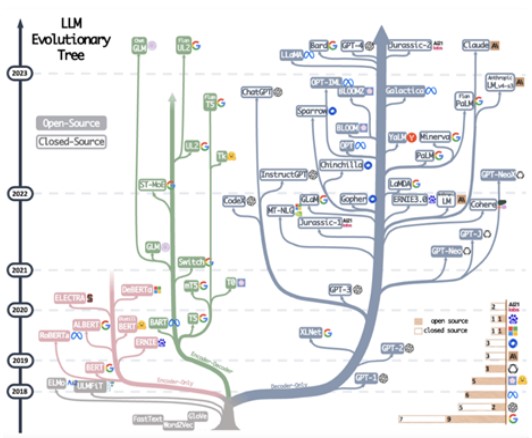
Figure 1. The evolutionary tree of LLM (Large Language Model) (Biocomm AI Blog, 2024)Figure 2 presents a study illustrating the time it takes for some of the most popular neural networks to reach 100 million users globally.
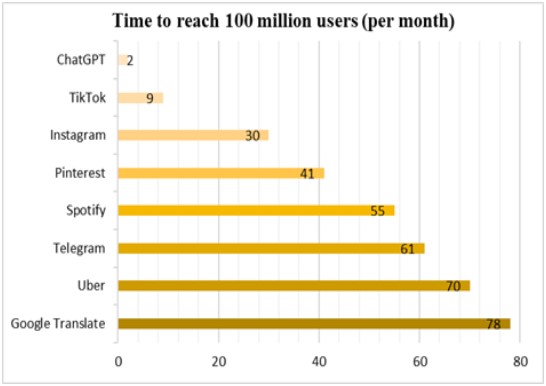
Figure 2. Time to reach 100 million users (per months) (Ebert & Louridas, 2023)This graph provides empirical evidence of the exponential growth in popularity of these technologies, highlighting their importance and influence in today's digital world.
There is a misconception about the role and limitless possibilities of artificial intelligence (AI). AI systems, including ChatGPT, cannot “mock” humans or make accurate predictions about the future. They are designed to provide information, help and answers based on data and algorithms that have been provided to them in their training.
The predictions an AI system can make are based on historical data analysis and trend modelling, but they always contain a degree of uncertainty and cannot predict the future with absolute accuracy. It is important to emphasize that these systems have no consciousness, emotion, or intent to mock humans. ChatGPT's response to the question to predict the future of the 21st century is a case in point (Figure 3).
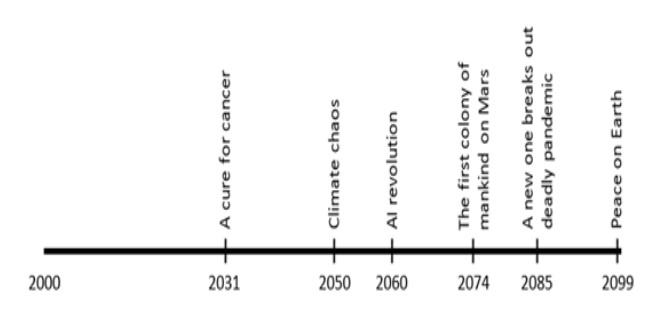
Figure 3. ChatGPT predictions for this century (Gogov, 2023)Neural networks are numerous in number and purpose as they find application in many different areas of life. There are more than 10,000 neural networks that are known all over the world and are used daily as assistants to people in a variety of activities. For example, neural networks are currently used in areas such as: security and defense, economics and finance, information technology and communications, marketing and advertising, health and medicine, research and analytics, robotics, education and hobby, entertainment and gaming, etc.
Some of the most common tasks performed by Artificial Intelligence (AI) can be summarized, focusing on areas where the application of AI can be carried out without significant risks and concerns. Activities that can be implemented using AI without causing serious concerns are the following:
- As an instant communication application – chat;
- Finding an answer to a complex, specific question;
- Writing an abstract, thesis or letter;
- Creating illustrations and multimedia files (sound and movies);
- Choosing music.
This approach allows a focus on the positive aspects and potential benefits of using AI, while also addressing areas where the technology can be applied safely and effectively.
When interacting with AI, it is important to follow certain ethical and practical guidelines to avoid potential risks and misuse. Some of the actions that are advisable to avoid are the following:
- Providing personal data.
- Providing sensitive information:
- Trusting its responses unconditionally:
Compliance with these principles is essential to ensure the ethical and safe use of AI, while ensuring that the rights and interests of users of such systems are protected.
- Model of activities in the application of artificial intelligence for decision support in management systems
Problem formulation represents a key stage in the process of developing and implementing artificial intelligence (AI). It involves identifying the specific problem or task to be solved using AI, and defining the goals and constraints of the project. This stage is usually implemented by a team of specialists including:
- Business Analysts: They play an important role in understanding the business needs and goals, as well as identifying the problems that can be solved using AI. Business analysts work closely with customers and stakeholders to define specific requirements and expected outcomes.
- Data Scientists: they are responsible for analyzing the available data and determining the appropriate methods and techniques to solve the problem. Data Scientists are also involved in pre-processing the data and selecting appropriate machine learning algorithms.
- Machine Learning Engineers: They are involved in the development and implementation of the AI models. Machine learning engineers select and configure the algorithms, train the models, and optimize them for maximum efficiency and accuracy.
- Software engineers: They take care of the integration of AI models into existing systems and applications. Software engineers also provide technical support and ensure that the system runs robustly and reliably.
- Project Managers: They coordinate the efforts of everyone involved in the process and ensure that the project is delivered on time and within budget. Project managers also communicate with clients and stakeholders to ensure that all requirements are met.
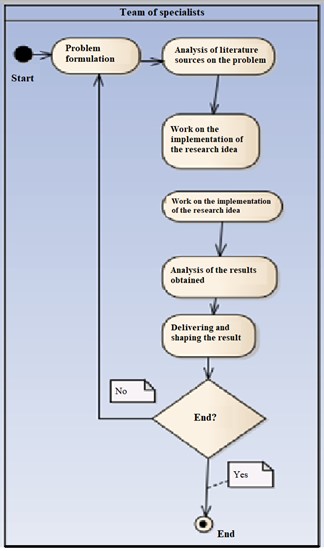
Figure 4. Model of activities in the application of AI for decision support in management systems
- Conclusions
Acknowledgements
This report was written thanks to funding from the Ministry of Education and Science in implementation of the National Strategy for Research Development 2017-2030 under the National Scientific Programme “Security and Defence”, adopted by Decision of the Council of Ministers No. 731 of 21 October 2021.
This publication was financed by the Ministry of Education and Science in implementation of the National Scientific Program – Security and Defence that is funded by Ministry of Education and Science of the Republic of Bulgaria in implementation of National Strategy for the Development of Scientific Research 2017 –2030 and was adopted by Decision of the Council of Ministers No. 731 of October 21, 2021.
REFERENCES
Biocomm AI Blog. (2024). Open source proliferation. https://blog.biocomm.ai/2023/05/14/open-source-proliferation-llm-evolutionary-tree/.
Booch, G., Rumbaugh, J., Jacobson, I. (1998). Unified Modeling Language User Guide. Addison Wesley.
Ebert, C., Louridas, P. (2023). Generative AI for Software Practitioners. IEEE Software, 40(4), 30 – 38. https://doi.org/10.1109/MS.2023.3265877.
Gogov, S. (2023, April 24). ChatGPT made 7 predictions for this century. Dir.bg. https://it.dir.bg/tehnologii/ai-nostradamus-napravi-7-prognozi-za-tozi-vek. [in Bulgarian]