
VOLATILE ORGANIC COMPOUNDS SAFETY LEVELS DURING CRUDE OIL SPILLS
Dobrin MilevORCID iD: 0009-0004-3671-036XNikola Vaptsarov Naval Academy – Varna, Bulgaria
Todor KoritarovORCID iD: 0000-0002-7712-8235Nikola Vaptsarov Naval Academy – Varna, Bulgaria
https://doi.org/10.53656/igc-2024.09

Pages 112-117
Abstract. During crude oil spills the personnel involved in the Oil industry and the emergency responders may be exposed to Crude Oil Volatile Compounds (VOC) following their release from the rig or the transportation vessel and migration through the water column to the ocean surface. In order to be prepared in case of such incidents, hand-held instruments are readily available and capable of measuring VOC in isobutylene units. Currently there’s no VOC emergency levels for crude oil vapors or developed correction factor for which to extrapolate the concentration of general VOC as isobutylene to the concentration of Crude Oil Volatile Compounds in the air. Therefore these levels must be set out as a recommendation for initial health and safety decision making immediately after an oil spill incident and for time framing during oil spill response. In this regard, the article explores the factors that influence the VOC concentration in crude oil following an accidental release and the subsequent risks associated with inhaling these vapors.
Keywords: maritime transport; Crude Oil Volatile Compounds; safety; oil spills
JEL: L91, Q53, J81
- Introduction
- Volatile organic compounds safety levels
The next step is to determine and validate a method of rapid and efficient detection of the quantity of compounds with readily available instrument in an offshore environment or during an accident (Dimitrakiev & Molodchik, 2018; Sterev, 2023). The multi-gas detectors are often provided with photoionization detectors and play the role of real time evaluators of atmospheric contaminants. The sensors of these detectors record general airborne volatile compounds and require the application of a scientifically developed chemical specific or mixture correction factor to accurately determine the quantity. The revision of the scientific literature shows that there’s no correction factor for the volatile organic compounds. There’s a necessity to establish such a correction factor when utilizing photoionization detectors for comparison of results to a safety level. There’re several approaches when developing correction factor for crude oil volatile organic compounds measurements including both a literature based mathematical approach and an empirical laboratory findings (IAPH, ICS & OCIMF, 2020).
A mathematical composition analysis approach is applied utilizing the molar composition of identified components a correction factor values for individual components. Airborne chemical mixture data are obtained from a variety of oil spill incidents as published in the scientific articles, including a seafloor release with exposure measured on oil rig. Based on this data the calculated correction factor varies between 1.2 – 2.54. slightly higher than the publications for the hydrocarbon mixtures. At the same time, a Chevron provided crude oil sample, is analyzed in the laboratory of the American National Institutes of Occupational Safety and Health for application in the empirical derivation of photoionization detector correction factor. The evaluation of vapor generated from the sample is set to 1.33 correction factor.
Generally considered for exposure scenario, a correction factor of 1.3 is recommended for crude oil vapors. Application of this factor to the 100 ppm crude oil volatile organic compounds safety levels shows that such a concentration is achieved when the multi-gas detector has a reading of 77 ppm, after a calibration of the instrument with isobutylene gas.
- Exposure scenario
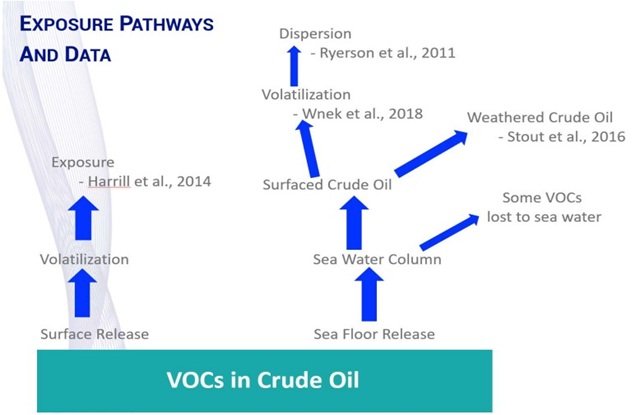
Figure 1. Exposure pathway and data for crude oil volatile organic compoundsThe presented exposure scenario considers a person involved in oil rig or platform industry, oil tanker shipping company, or part of oil spill response team. The worker is assumed to be present during the first 24 hours of the spill and exposed via inhalation only. The crude oil involved is released at the seabed and reaches the surface after hundred of meters. The surfaced oil is fresh, not weathered, and the VOC released will be those immediately released, or released during the initial minutes or hours of surfacing. Released crude oil continuing to surface is replenishing the VOC which may have dissipated due to wind drift or rising through the atmosphere.
In this way, the mixture of volatile organic components to which the personnel is expected to be exposed will be a subset of the component present in crude oil, reduced by concentration of pressure based off-gassing and solubilization in seawater, and low vapor pressure of some remaining components on the surface. The exposure pathway is traced in Figure 1.
- Conceptual model of volatile organic compounds impacts
The model is based on the volatile constituents of source crude oil, found in some samples. The VOC content of crude oil types in the Gulf of Mexico is targeted in the model.
Source: Surfaced, non-burning crude oil
The exposure scenario includes accidental release of crude oil from seabed drilling operations. The source of the exposure is crude oil released at the sea floor and surfaced by moving upward through the water column.
Exposure media: Air
The exposure is characterized by the volatilization of crude oil volatiles in the ambient air. Thus it is assumed that individuals working on the spot may experience an inhalation exposure as part of their occupational work adjacent to surfaced oil.
Receptors: Humans (Occupational)
For the purpose of risk assessment, the target receptor is human. Furthermore, due to the job description and location, this population likely represents “healthy workers”, thus minimizing the potential for exposure to sensitive sub-populations. Humans exposed via inhalation to elevated levels of released volatile organic compounds in an acute scenario may experience symptoms of irritation and at higher levels intoxication.
Attribute change: Irritation
When exposed to crude oil volatiles can result in several types of acutely manifested as well as delayed effects, this model is focused on the initial sign of exposure and potential intoxication. Reliance on irritation as the sentinel effect will be protective against more serious effects which occur with increasing concentration.
- Conclusions
The purpose of the research is to establish reliable tool as an action level for crude oil volatile organic compounds. Using the proposed action level of 100 ppm, with 1.33 applied for up to 24 hours of exposure is expected to be protective against mild, irritant effects. Based on the dose-response relationship established in the emergency planning response guidelines, this value of 100 ppm is ten-fold lower than the value established for more severe effects, which include dizziness. The photoionization detectors correction factor of 1.3 recommended for crude oil vapors can be used in rapid-reading instrumentation to effectively quantify the action level concentration.
REFERENCES
AIHA. (2017). Emergency Response Planning Guidelines and Workplace Environmental Exposure Levels. American Industrial Hygiene Association.
Conev, I. & Dimitrakiev, D. (2023). Use of Modern Technologies at Naval Academy Varna. Proceedings of the International Association of Maritime Universities (IAMU) Conference, 129 – 135.
Dimitrakiev, D. & Gilev, G. (2021). Green Ports – Environmental Challenges and Economic Demands. Pedagogika-Pedagogy, 93(7s), 132 – 140. https://doi.org/10.53656/ped21-7s.11gree
Dimitrakiev, D. & Molodchik, A. (2018). Digital Platforms as Factor Transforming Management Models in Businesses and Industries. Journal of Physics: Conference Series, 1015, 042040. https://doi.org/10.1088/1742-6596/1015/4/04204
Dimitrakiev, D., Stankov, V. & Atanasova, C. (2023). Simulator Training - Unique Powerful Instrument for Educating, Skills Creating, Mitigating Skills and Resilience Creating. Strategies for Policy in Science and Education, 31(6s), 103 – 111. https://doi.org/10.53656/str2023-6s-9-sim
Dimitrakieva, S., Kostadiniv, O. & Atanasova, K. (2023). Pools in Tramp Shipping and the Rules on Competition Given the Art. 101 of the Treaty on the Functioning of the European Union. Strategies for Policy in Science and Education, 31(3s), 140 – 147. https://doi.org/10.53656/str2023-3s-11-poo
Dimitrakieva, S., Kostadinov, O. & Atanasova, K. (2021). Multilevel Demand for Sea Transportation: Correlation between Baltic Dry Index (BDI) and Coaster Shipping Prices for Sea Routes between Baltic Seaports and Mediterranean Seaports. Pedagogika-Pedagogy, 93(7s), 141 – 148. https://doi.org/10.53656/ped21-7s.12corr
Harill, J. A., Wnek, S. M., Pandey, R. B., Cawthon, D., Nony, P. & Goad, P. T. (2014). Strategies for Assessing Human Health Impacts of Crude Oil Releases. International Oil Spill Conference Proceedings, 2014(1), 1668-1685. https://doi.org/10.7901/2169-3358-2014.1.1668
IAPH, ICS & OCIMF. (2020). International Safety Guide for Oil Tankers and Terminals (ISGOTT 6). (6th Ed.).
Narleva, K. & Gancheva, Y. (2023). The Role of Maritime Education in Digitalization. Pedagogika-Pedagogy, 95(6s), 132 – 141. https://doi.org/10.53656/ped2023-6s.12
Ryerson, T. B., Aikin, K. C., Angevine, W. M., Atlas, E. L., Blake, D. R., Brock, C. A., Fehsenfeld, F. C., Gao, R.-S., Gouw, J. A., … & Watts, L. A. (2011). Atmospheric Emissions from the Deepwater Horizon Spill Constrain Air-water Portioning, Hydrocarbon Fate and Leak Rate. Geophysical Research Letters, 38(7), L07803. https://doi.org/10.1029/2011GL046726
Sterev, N., (2023). Pre-Incubation Toolkits for Academic Entrepreneurship Fostering: Bulgarian Case. Strategies for Policy in Science and Education, 31(3s), 90 – 103. https://doi.org/10.53656/str2023-3s
Stout, S. A., Payne, J. R., Emsbo-Mattingly, S. D. & Baker, G. (2016). Weathering of Field-Collected Floating and Stranded Macondo Oils During and Shortly after the Deepwater Horizon Oil Spill. Marine Pollution Bulletin, 105(1), 7 – 22. https://doi.org/10.1016/j.marpolbul.2016.02.044
Wnek, S. M., Kuhlman, C. L., Harrill, J. A., Nony, P. A., Millner, G. C. & Kind, J. A. (2018). Forensic Aspects of Airborne Constituents Following Releases of Crude Oil into the Environment. In S. A. Stout, Z. Wang (Eds.), Oil Spill Environmental Forensics Case Studies (pp. 87 – 115). Elsevier. https://doi.org/10.1016/B978-0-12-804434-6.00005-7