
IMPACT OF CORPORATE CULTURE PUBLICIZED ON THE INTERNET ON THE ORGANIZATIONAL PERFORMANCE OF INSURANCE COMPANIES IN BULGARIA
Ilian MinkovORCID iD: 0009-0000-3426-1880University of Economics – Varna, Bulgaria
Yordan IvanovUniversity of Economics – Varna, Bulgaria
https://doi.org/10.53656/igc-2024.31

Pages 366-375
Abstract. The corporate culture of business organizations publicized on the Internet has a positive influence on their image, but its impact on organizational performance and results has not been indisputable. In this regard, the purpose of this paper is to establish the correlation between the degree of development of the corporate culture of insurance companies in Bulgaria publicized on the Internet and their organizational performance, measured by the return on equity. The results obtained on the nature of this correlation in insurance companies show that it is rather weak, with the number of all publicized elements having a stronger positive influence than the number of only the primary ones.
Keywords: publicized corporate culture, insurance companies, primary elements, secondary elements
JEL: G22, M14
- Introduction
For companies from the Bulgarian insurance sector, as providers of financial services in a highly competitive market, it is undoubtedly of great importance to create a unique image in the eyes of customers and other market participants. At the same time, it is debatable whether this affects the market performance and success of these organizations. In view of this, the purpose of this paper is to establish the correlation between the degree of development of the corporate culture of insurance companies in Bulgaria publicized on the Internet and their organizational performance, measured by the return on equity.
- Literature review
The publicized culture of companies is expressed through numerous cultural elements, presented in writing, through which certain messages are sent to customers and other internal and external stakeholders. It is precisely with regard to the elements that make up this culture that the greatest differences between individual researchers are observed. A large group of authors (Sipayung, Fomunyam, Oznacar & Celik, Carvalho, Lee, Pamungkas, T. et al.) hold the view that the primary elements of publicized culture include corporate mission, vision and values. This point of view is not without logic, as these are the three key components of every company’s strategic direction and determine its long-term goals and priorities. At the same time, it should be noted that companies publish many other documents online, each outlining certain characteristic features of the organizational profile – motto, credo, company history, code of ethics, slogan, manifesto, etc. A proponent of this view is K. Dimitrov, who in two large-scale studies of a significant number of companies, members of certain Bulgarian employers’ organizations (Dimitrov, Ivanov & Geshkov, 2018; Dimitrov, Dimitrov & Slavova, 2024), derives a total of 22 elements of the publicized culture, including such exotic and very rare elements as an organizational mantra, a goal-orientation toward great and deep change, and a goal toward a giant leap. However, in this author’s research, there is no ranking of the individual elements by degree of importance and contribution to the companies’ communication policy.
Based on the literature review, we came to the conclusion that the structure of the publicized corporate culture consists of elements of lower and higher rank. Similarly to most researchers, we believe that three proclamations are paramount for its construction – those concerning the mission, vision and values/principles of the organization. In our opinion, these elements can be defined as being of primary importance for the culture, as they constitute the foundation around which other documents of lesser importance are built up. The scope of lower-ranking elements includes those that are publicized relatively frequently on company websites, but whose role in the communication policy is mainly to add value to the messages of the primary documents. For the purposes of the present study, we assume that such a role is played by eight elements – business credo, motto, history, corporate social responsibility and code of ethics. They can be defined as secondary elements in the portfolio of publicized culture.
Recent studies of the relationship between elements of official culture publicized on the Internet and various aspects of organizational performance in organizations of diverse nature and lines of business show that the impact is rather positive (Table 1).
Table 1. Findings from studies on the relationship between publicized company culture and organizational performance
| Author | Results |
| Jonyo, Ouma & Mosoti (2018) | The impact of mission and vision on the organizational performance of 17 private universities in Kenya is studied. A significant positive impact of changes in the mission and vision on the organizational performance of educational institutions is established. |
| Dermol & Širca (2018) | The paper examines the influence of the publicized missions and values of a sample of Slovenian companies on their organizational performance. The results show a positive correlation between the existence of publicized corporate mission and organizational values and their communication within the company, on the one hand, and some of the non-financial aspects of company performance, on the other. |
| Sipayung et al. (2019) | The relationship between the corporate image of consumer goods enterprises and their mission statements and the manner of their presentation is analyzed. The results show that a good formulation of the mission has a strong positive relationship with the company’s image and organizational performance. |
| Aldhaheri, Ameen & Isaac (2020) | Explores the impact of the formulation of mission, vision and goals on staff training and development within the UAE public sector. The results of the study render the conclusion that there is a significant and positive impact on organizational performance. |
| Pamungkas et al. (2024) | The purpose of the study is to demonstrate the effect of the vision and mission on the work of Hospital in Asia. The results show that there is a relationship between organizational culture, the vision and mission and the level of effectiveness and efficiency of the hospital facility. |
| Catindig & Matriano (2024) | This study outlines a strong positive impact of secondary school teachers’ perceptions of the vision, mission, and goals on their commitment to the respective organizations. Alignment between personal values and organizational values has been found to play a critical role in strengthening commitment and fostering people’s sense of belonging. |
- Methodological tools and research results
There is a certain variety of profitability indicators (Petrov et al., 2006). Given that the publicized corporate culture is relevant to all stakeholders in a company, we believe it is appropriate to look for a relationship between the degree of its development, measured by the number of publicized elements online (primary and in total) and the performance of insurance companies, measured by the return on equity. In this regard, it can be pointed out that the return on equity is measured by the ratio of the net financial result and the amount of equity (Kostova, 2010):

Formula 1. Net return on equity ratiowhere
Rprof(Eq) – return on equity ratio;
NPr - net profit (loss) of the company;
Eq – net sales revenue.
The calculation of the return on equity of insurance companies, members of the Association of Bulgarian Insurers, was carried out on the basis of the formula presented above, using data from the annual financial reports and activity reports on the companies’ websites. The indicators for the selected companies were determined based on data for 2023, and a return on equity ratio was calculated for each of them (table 2).
Table 2. Return on equity of insurance companies in Bulgaria for 2023
| Insurance company | Eq | Pr(net) | Rprof(Eq) |
| Bulgaria Insurance - Sofia | 9091 | 518 | 5.70% |
| UNIQA – Sofia | 29386 | 5049 | 17.18% |
| OZK-Insurance – Sofia | 30973 | 5400 | 17.43% |
| Colonnade Insurance S.A. – Bulgaria branch – Sofia | 116094 | 8089 | 6.97% |
| Asset Ins – Sofia | 7823 | 678 | 8.67% |
| Euroins – Sofia | 70642 | 9916 | 14.04% |
| Groupama Zastrahovane – Sofia | 36535 | 5679 | 15.54% |
| DZI – General Insurance – Sofia | 194173 | 78357 | 40.35% |
| Armeec – Sofia | 117526 | 34423 | 29.29% |
| Generali Insurance – Sofia | 141009 | 15117 | 10.72% |
| BUL INS – Sofia | 64052 | 268 | 0.42% |
| BAEZ – Bulgarian Export Insurance – Sofia | 28906 | 808 | 2.80% |
| Lev Ins – Sofia | 51800 | 4588 | 8.86% |
| Allianz Bulgaria – Sofia | 7500 | 2939 | 39.19% |
| Bulstrad Vienna Insurance Group – Sofia | 194368 | 38534 | 19.83% |
| Saglasie – Sofia | 9037 | 1077 | 11.92% |
| CCB Life – Sofia | 9412 | 159 | 1.69% |
| Euroins Life – Sofia | 11498 | 240 | 2.09% |
| Grawe Bulgaria Life Insurance – Sofia | 59203 | 10333 | 17.45% |
| Bulstrad Life Vienna Insurance Group – Sofia | 56367 | 12466 | 22.12% |
| MetLife Europe d.a.c. – Bulgaria branch | 1304000 | 166000 | 12.73% |
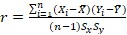
Formula 2. Bravais-Pearson correlation coefficientThis correlation belongs to the group of parametric methods, which means that it should only be applied to parametric series with a normal distribution. This is precisely what necessitates determining the type of data series and distribution using the Kolmogorov-Smirnov Sample Test.
The statistical significance of the simple linear correlation coefficient is determined by the classical method of statistical hypothesis testing. The two hypotheses are of the following type (Radilov, Hadzhiev & Zhekova, 2010):
H0 : ρ = 0 (assumption of zero effect of the factor on the result)
H1 : ρ ≠ 0 (the alternative hypothesis is opposite to the null hypothesis)
Empirical characterization of null hypothesis testing
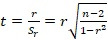
Formula 3. Empirical characterization of statistical hypotheses testing.The decision to accept or reject the null hypothesis is based on the comparison between the obtained empirical and theoretical characterization from the t-distribution table at a chosen level of significance and degree of freedom n – 2.
In the present study on the existence of a correlation between the number of elements (primary and in total) of the corporate culture publicized on the Internet and the return on equity of insurance companies in Bulgaria, a risk of error of the first kind α=0.05 is assumed, whereby, in our opinion, the risks that may arise from distortion of the results caused by the small number of respondents and the way the sample was formed are fully reflected.
The results of the Kolmogorov-Smirnov Sample Test (Table 3) and the assumed risk of error of the first kind warrant the conclusion that the distribution is normal.
Table 3. Results of the Kolmogorov-Smirnov test for normal distribution of the statistical series
| Total elements | Primary elements | Return on equity | ||
| N | 21 | 21 | 21 | |
| Normal Parametersa,b | Mean | 3,2857 | 1,6190 | ,1452 |
| Std. Deviation | 1,58565 | 1,16087 | ,11030 | |
| Most Extreme Differences | Absolute | ,220 | ,200 | ,173 |
| Positive | ,220 | ,157 | ,173 | |
| Negative | -,146 | -,200 | -,094 | |
| Kolmogorov-Smirnov Z | 1,007 | ,917 | ,793 | |
| Asymp. Sig. (2-tailed) | ,262 | ,370 | ,555 | |
| a. Test distribution is Normal.
b. Calculated from data. | ||||
H0 – there is no statistically significant correlation between the number of corporate culture elements publicized on the Internet (primary and in total) and return on equity.
H1 – there is a statistically significant correlation between the number of corporate culture elements publicized on the Internet (primary and in total) and return on equity.
Table 4. Correlation between the number of the total (primary and secondary) publicized elements of corporate culture and the return on equity in insurance companies in Bulgaria
| Value | Asymp. Std. Errora | Approx. Tb | Approx. Sig. | ||
| Interval by Interval | Pearson's R | ,171 | ,183 | ,757 | ,458c |
| Ordinal by Ordinal | Spearman Correlation | ,283 | ,196 | 1,286 | ,214c |
| N of Valid Cases | 21 | ||||
| a. Not assuming the null hypothesis.
b. Using the asymptotic standard error assuming the null hypothesis. c. Based on normal approximation.
| |||||
Table 5. Correlation between the number of publicized primary elements of corporate culture and the return on equity in insurance companies in Bulgaria
| Value | Asymp. Std. Errora | Approx. Tb | Approx. Sig. | ||
| Interval by Interval | Pearson's R | ,188 | ,171 | ,835 | ,414c |
| Ordinal by Ordinal | Spearman Correlation | ,210 | ,209 | ,936 | ,361c |
| N of Valid Cases | 21 | ||||
| a. Not assuming the null hypothesis.
b. Using the asymptotic standard error assuming the null hypothesis. c. Based on normal approximation.
| |||||
- Conclusion
REFERENCES
Aldhaheri, F., Ameen, A. & Isaac, O. (2020). The Influence of Strategy Formulation (Vision, Mission, and Goals) on the Organizational Operations. Journal of Critical Reviews, 7(17), 1932-1941.
Awino, Z., Muteshi, D.C., Kitiabi, R., & Pokhariyal, G. (2018). Firm-Level Strategy, Organization Culture, and Performance of Food and Beverage Manufacturing Firms in Kenya. International Journal of Business and Management, 13(8), 224 – 224. https://doi.org/10.5539/ijbm.v13n8p224
Catindig, R. & Matriano, E. (2024) School Vision, Mission, and Goals: Insights from Employees During the General Orientation and Reorientation Program. Institutional Multidisciplinary Research and Development Journal, 7(2), 304 – 331.
Dermol, V. & Širca, N. T. (2018). Communication, Company Mission, Organizational Values, and Company Performance. Procedia-social and behavioral sciences, 238, 542 – 551.
Desselle, S. P., Zgarrick, D. & Ramachandran, S. (2022). Variability in Perceptions of Organizational Culture Across U.S. Colleges and Schools of Pharmacy. Research in Social and Administrative Pharmacy, 18(4), 2600 – 2605. https://doi.org/10.1016/j.sapharm.2021.04.025
Dimitrov, K., Dimitrov, K. & Slavova, P. (2024) Organizatsionno liderstvo chrez provazglasena kultura. Izd. kompleks – UNSS.
Dimitrov, K., Ivanov, I. & Geshkov, M. (2018) Proklamiranata firmena kultura vav virtualnoto prostranstvo. Izd. kompleks – UNSS.
Idris, I., Suyuti, A., Supriyanto, A.S., & As, N. (2022). Transformational Leadership, Political Skill, Organizational Culture, And Employee Performance: A Case From Tourism Company in Indonesia. Geojournal of Tourism and Geosites, 40(1), 104 – 110. https://doi.org/10.30892/gtg.40112-808
Idriz, F. & Geshkov, M. (2023). Effective Management of Human Resources in Tourism through Motivation. Strategies for Policy in Science and Education, 31(3s), 126 – 139. https://doi.org/10.53656/str2023-3s-10-eff
Jonyo, B. O., Ouma, C. & Mosoti, Z. (2018). The Effect of Mission and Vision on Organizational Performance within Private Universities in Kenya. European Journal of Educational Sciences, 5(2), 15 – 33. http://dx.doi.org/10.19044/ejes.v5no2a2
Kostova, N. (2010) Financial-accounting analysis. Active-К Ltd.
Minkov, I. & Ivanov, Y. (2023) Impact of the Publicization of Corporate Culture on the Internet on the Financial and Economic Indicators of Courier Companies in Bulgaria. Strategies for Policy in Science and Education, 31(6s), 94 – 102. https://doi.org/10.53656/str2023-6s-8-imp
Munir, S., Abdul Rasid, S.Z., Aamir, M., Jamil, F. & Ahmed, I. (2023). Big Data Analytics Capabilities and Innovation Effect of Dynamic Capabilities, Organizational Culture, and Role of Management Accountants. Foresight, 25(1), 41 – 66. https://doi.org/10.1108/FS-08-2021-0161
Pamungkas, T., Firdaus, M. S., Putra, D. P., Gultom, L. R. S., Rahmat, A., Dipa, I. B. G. K., Karsontani, R. & Veranita, M. (2024). The Effect of Vision and Mission Statement on Performance of Hospital in Asia: A Systematic Review. Journal of Advanced Research in Medical and Health Science, 10(2), 194 – 198. https://doi.org/10.61841/8hkzz628
Petrov, G., Raikov, E., Tsankova, E., Marinkov, G., Kostov, I. & Glaveva, M. (2006) Corporate Finance. Trakia-M.
Radilov, D., Hadziev, V. & Zhekova, S., (2010) Statistics. UE-Varna.
Sareen, A. & Pandey, S. (2022). Organizational Innovation in Knowledge-Intensive Business Services: The role of Networks, Culture and Resources for Innovation. FIIB Business Review, 11(1), 107 – 118. https://doi.org/10.1177/23197145211020737
Sipayung, F., Ginting, L. & Sibarani, M. L. L. (2019) Vision & Mission, Organizational Performance and Corporate Image on Consumer Goods Company. Asia Proceedings of Social Sciences, 4(3), 76 – 79. https://doi.org/10.31580/apss.v4i3.782
Zen, A., Yanti, S., Hutomo, M. R., Kraugusteeliana, K., & Arisutama, H. Y. (2023). The Role of Leadership in Managing Organisational Culture Change in the Context of Information Technology Implementation. Jurnal Minfo Polgan, 12(1), 1247 – 1255. https://doi.org/10.33395/jmp.v12i1.12697