
ARTIFICIAL INTELLIGENCE AS A RISK TREATMENT TOOL IN THE CIRCULAR ECONOMY
ORCID iD: 0000-0001-9430-773X
University of National and World Economy - Sofia, Bulgaria
https://doi.org/10.53656/igc-2024.05

Pages 49-59
Abstract. Business organizations are increasingly thinking about closing the production loop and moving closer to the so-called circular economy. On the other hand, changing from a linear model to a circular one is accompanied by many difficulties and unknowns. Achieving a regenerative system with zero waste emissions, full resource recovery, recycling and reuse poses a number of risks for business. This paper explores the possibility of using AI as an effective means of addressing risk in the transition to a circular economy and Industry 5.0. The results of the study identify the main relevant groups of risks and propose a methodology for their treatment, through different AI tools. This allows to achieve higher competitiveness and a smooth entry into Industry 5.0.
Keywords: Current Economic; Risk; Relationships of Circular Products
JEL: O10, O25, O32
- Introduction
The research question posed in this paper is what are the main risk groups threatening the transition to a circular economy and how can AI reduce their frequency and or severity of impact? To answer this question, the paper sequentially presents the following parts: a backgrounder on AI in the circular economy, aiming to identify main directions of AI application to support the process; main groups of risks associated with AI application in the circular economy; research methodology and Results. The results of the study present a concept for addressing one of the most prevalent risk groups in the circular economy, namely the risks associated with the relationships and decision making between the actors in the circular product chain. The added value of this risk treatment measure lies in the support of the process with intelligent analysis by artificial intelligence.
- AI in CE Background
To highlight the clear contributions of AI to the circular economy, this paper identifies three key areas of application presented in Figure 1.
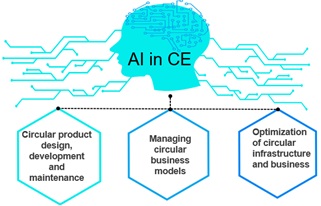
Figure 1. AI contribution fields in CE2.1. Design, development and maintenance of circular products
A fundamental requirement of CE products is to innovate in terms of the utility and value of products, components and materials at any time (Ghoreishi & Happonen, 2020) of their life cycle. This increases their lifetime and that of the materials they are composed of: reuse cycles, repair, recycling of components, etc. To fulfil this requirement, AI is used as a useful tool. AI improves and accelerates the development of new products, components and materials suitable for a circular economy through iterative design processes aided by machine learning (Akinode & Oloruntoba, 2020). This enables the testing and development of prototypes and innovations meeting circularity product requirements. As a result, the amount of resources required and the production of product waste can be significantly reduced. At the same time, AI helps to predict the variation of material requirements over time, their overall durability and potential toxicity (Pregowska et al., 2022). In terms of maintenance of circular products, AI is used to analyze data collected throughout the product life cycle. Based on these, real-time performance improvements are made or it is determined whether a returned product should be reused, remanufactured or recycled (Blunck et al., 2019).
2.2. Managing circular business models
AI increases the competitive strength of business models in the circular economy, such as product, service and leasing. By combining real-time and historical product and user data, AI contributes to increasing product circulation and asset utilization, through pricing and demand forecasting, predictive maintenance, and intelligent inventory management (Akinode & Oloruntoba, 2020). Di Vaio and his team (2020) demonstrate the involvement and importance of AI in the introduction of new business models implementing CE principles (Di Vaio et al., 2020). Some of the main advantages of AI in the management of circular business models are associated with the ability to analyze large sets of consumer data in real time, informing predictive demand and pricing (Aktepe et al, 2021). Another advantage is the so-called predictive maintenance, where it can extend the life of equipment by minimizing costs and the use of spare parts (Carvalho et al., 2019), before machine failure and business process shutdown.
2.3. Optimising circular infrastructure and business
Among the basic principles of the circular economy is the closure of the complete production cycle. To achieve this, a functioning reverse logistics system is required, with efficient processes for sorting and disassembling products, remanufacturing components and recycling materials (Akinode & Oloruntoba, 2020). AI has the resource to support the circulation of products and materials throughout the supply chain. For example, through IoT and AI algorithms, high quality in recognition and imaging can be achieved (Wilson et al., 2022). The combination of IoT with robotics allows to significantly increase the quality of sorting processes of mixed material streams (Schmidt et al., 2021), differentiate waste, facilitate recycling minimizing resource waste (Roberts et al., 2024). Another aspect accounting for AI contributions in the circular economy focuses on energy optimization in manufacturing processes. For example, businesses running large database arrays require large electricity consumption for server maintenance and cooling. AI has the ability to analyse and optimize the energy consumption used (Roberts et al., 2024).
- Main groups of risks related to the application of AI in the circular economy
The complexity of relationship management in CE comes from the involvement of multiple stakeholders throughout the chain. This requires a high degree of collaboration between parties and harmonization of their decisions (Alexandris et al., 2018). Cooperative networks, with full systems compatibility (Ramadoss et al., 2018), are needed to provide information on the status of materials and production throughout the chain. In turn, the open nature of data collection and analysis exacerbates the risks associated with information privacy (Roberts et al., 2024). Risks associated with governance and decision-making fall into the same range of risks. In a sustainable supply chain, proper decision making is important for effective implementation of CE, but its alignment with other actors and a complex and lengthy process. Knowledge and information sharing are key factors in supply chain decision making. Furthermore, communication between partners is supported by the information technology infrastructure (Govindan & Hasanagic, 2018), which poses several technical risks. Common decisions in the supply chain also provoke several risks related to not obtaining unanimous opinions and their compatibility between partners.
In a closed production cycle involving multiple actors, several risks related to the overall integration and integrity of the data become apparent. CE requires information to be shared between different actors, but this is not always a good option for them. Their concerns are primarily related to the sharing of know-how and new knowledge, which is of a confidential nature. Exporting new knowledge through collaboration with suppliers is problematic in situations of technology confidentiality (Govindan et al., 2014), as it can harm their competitiveness (Rizos et al., 2016). Integration with IT systems and scheduling issues are other causes of supply chain integrity (Bressanelli et al., 2018).
Although schematically viewed without going into detail it becomes apparent that circular production is difficult to achieve. Apart from the range of risks associated with the integration of the actors in between, it must be borne in mind that the manifestation of a risk is not isolated. The occurrence of the risk will have an impact on all actors in the chain, and will also generate a knock-on effect, triggering the manifestation of a range of other risks. This makes it necessary to look for intelligent solutions to risk treatment.
- Research methodology
- Results and discussion
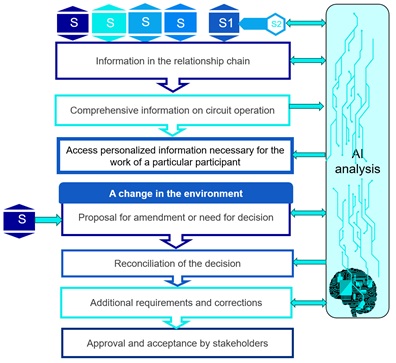
Figure 2. Conceptual diagram for intelligent treatment of risk associated with closed-loop relationships of circular productsIt should be noted here that the mentioned concept assumes that the whole process is supported by intelligent analysis performed using AI and ML (machine learning). The specific algorithms and tools are not the subject of research here. To illustrate the concept, it is important to show how the whole process is supported rather than the specific intelligent toolkit. This solution is suitable for treating the risks associated with making decisions that have an impact on the activities of all actors in the circular product chain. The concept goes through the following steps:
– Identify all stakeholders in the chain of relationships. In the first place, it is necessary to illustrate all actors involved in the circular product. They can be conventionally divided into direct stakeholders (S), indirect stakeholders (S1). S refers to all those who are directly involved in the creation of the circular product or it is all the main actors in the chain. In their interrelationship the risks with the highest frequency and severity of consequences arise. S1 are all stakeholders who are relevant to the process but not directly involved, such as regulators. The concept foresees conducting an intelligent analysis of the presence of new actors. This is done by semantic analysis of unstructured databases and online information. Thus, if an indirect actor (S2) appears then it will be recognized and its benefits and threats to the whole chain will be identified. AI analysis examines the legal robustness of potential actors, requirements for dealing with them and their reputation. From this analysis comes approval or not for inclusion in the chain.
– Information in the chain of relationships. Secondly, it is necessary to define all the information needed to work in the chain. It is conventionally divided into two groups: information public to the chain, necessary to carry out the business processes of all participants; and personal information concerning the activities of each individual participant. At this stage, it is important to correctly define access rights to the information in the chain according to the needs of the actors and the security requirements of each actor.
– Change under the influence of environmental dynamics. This is where the risk treatment mechanisms of this conceptual model come into play. Change (the need for a solution) can be triggered either by a stakeholder and/or by the AI. The suggestion of an amendment or need for a decision prompted by the system is based on informed recommendations and decisions from the ML and the AI. Alternatively, the decision may arise from a specific stakeholder and or multiple stakeholders. In order to minimize risk, it is required to be treated predicatively, i.e., the given decision must be agreed upon by all stakeholders before tensions arise between them. This is where the benefits of system intelligence can be seen. The AI conducts an analysis with the possible consequences for each specific participant. This allows obtaining an adequate analysis of multiple interrelated factors in real time. On this basis, each participant reconciles the decision with options to specify additional conditions or modifications in detail. The AI summarizes the solutions and suggests alternatives that would best satisfy all parties.
– Coordination in the chain. Intelligent system sending to all participants and visualizing the specifics that directly affect their interests and activities.
– Analysing decisions and giving suggestions. In the next iteration, participants have the alternative to accept the proposed solution and or propose additional requirements to it. The number of iterations here continues until agreement is reached in the chain of relationships.
– Generalization of proposals and AI analysis. By intelligently generating the “hit solution”, all participants obtain the best alternative within the specific parameters relative to their activity.
– Validation by stakeholders. The final stage is followed by validation of the solution by all parties and passing its action.
- Conclusion
Acknowledgements
This article was financially supported by the UNWE Science Fund (contract No. 5/2023).
REFERENCES
Akinode, J. & Oloruntoba, S. (2020). Artificial Intelligence in the Transition to Circular Economy. American Journal of Engineering Research, 9(6), 185 – 190.
Aktepe, A., Yanik, E. & Ersöz, S. (2021). Demand Forecasting Application with Regression and Artificial Intelligence Methods in a Construction Machinery Company. Journal of Intelligent Manufacturing, 32, 1587 – 1604. https://doi.org/10.1007/s10845-021-01737-8
Alexandris, G., Katos, V., Alexaki, S. & Hatzivasilis, G. (2018). Blockchains as Enablers for Auditing Cooperative Circular Economy Networks. In IEEE 23rd international workshop on computer aided modeling and design of communication links and networks (CAMAD) (pp. 1 – 7). IEEE. https://doi.org/10.1109/CAMAD.2018.8514985
Barteková, E. & Börkey, P. (2022). Digitalisation for the Transition to a Resource Efficient and Circular Economy. OECD Environment Working Papers, 192. https://doi.org/10.1787/6f6d18e7-en
Blunck, E., Salah, Z. & Kim, J. (2019). Industry 4.0, AI and Circular Economy - Opportunities and Challenges for a Sustainable Development. Proceedings of Dubrovnik International Economic Meeting (DIEM), 17 – 42. https://www.diem-dubrovnik.com/diem/files/2019/Abstracts_DIEM_2019.pdf
Bressanelli, G., Adrodegari, F., Perona, M. & Saccani, N. (2018). The Role of Digital Technologies to Overcome Circular Economy Challenges in PSS Business Models: An Exploratory Case Study. Procedia CIRP, 73, 216 – 221. https://doi.org/10.1016/j.procir.2018.03.322
Carvalho, T., Soares, F., Vita, R., Francisco, R., Basto, J. & Alcalà, S., (2019). A Systematic Literature Review of Machine Learning Methods Applied to Predictive Maintenance. Computers & Industrial Engineering, 137, 106024. https://doi.org/10.1016/j.cie.2019.106024
Chauhan, C., Dhir, A., Akram, M. & Salo, J. (2021). Food Loss and Waste in Food Supply Chains: A Systematic Literature Review and Framework Development Approach. Journal of Cleaner Production, 295, 126438. https://doi.org/10.1016/j.jclepro.2021.126438
Chauhan, C., Parida, V. & Dhir, A. (2022). Linking Circular Economy and Digitalisation Technologies: A Systematic Literature Review of Past Achievements and Future Promises. Technological Forecasting Social Change, 177, 121508. https://doi.org/10.1016/j.techfore.2022.121508
Da Silva, T. & Sehnem, S. (2022). The Circular Economy and Industry 4.0: Synergies and Challenges. Revista de Gestão, 29(3), 300-313. https://doi.org/10.1108/REGE-07-2021-0121
Di Vaio, A., Palladino, R., Hassan, R. & Escobar, O. (2020). Artificial Intelligence and Business Models in the Sustainable Development Goals Perspective: A Systematic Literature Review. Journal of Business Research, 121, 283 - 314. https://doi.org/10.1016/j.jbusres.2020.08.019
Ghisellini, P., Cialani, C., & Ulgiati, S. (2016). A Review on Circular Economy: The Expected Transition to a Balanced Interplay of Environmental and Economic Systems. Journal of Cleaner production, 114, 11 – 32. https://doi.org/10.1016/j.jclepro.2015.09.007
Ghoreishi, M. & Happonen, A. (2020). New Promises AI Brings into Circular Economy Accelerated Product Design: A Review on Supporting Literature. E3S Web of Conferences, 158, 06002. https://doi.org/10.1051/e3sconf/202015806002
Govindan, K. & Hasanagic, M. (2018). A systematic Review on Drivers, Barriers, and Practices Towards Circular Economy: A Supply Chain Perspective. International Journal of Production Research, 56(1-2), 278 - 311. https://doi.org/10.1080/00207543.2017.1402141
Govindan, K., Kaliyan, M., Kannan, D. & Haq, A. (2014). Barriers Analysis for Green Supply Chain Management Implementation in Indian Industries Using Analytic Hierarchy Process. International Journal of Production Economics, 147, 555 – 568. https://doi.org/10.1016/j.ijpe.2013.08.018
Morseletto, P. (2020). Restorative and Regenerative: Exploring the Concepts in the Circular Economy. Journal of Industrial Ecology, 24(4), 763 – 773. https://doi.org/10.1111/jiec.12987
Noman, A., Akter, U., Pranto, T. & Haque, A. (2022). Machine Learning and Artificial Intelligence in Circular Economy: A Bibliometric Analysis and Systematic Literature Review. Annals of Emerging Technologies in Computing (AETiC), 6(2), 13 – 40. https://doi.org/10.33166/AETiC.2022.02.002
Pathan, M., Richardson, E., Galvan, E. & Mooney, P. (2023). The Role of Artificial Intelligence within Circular Economy Activities – A View from Ireland. Sustainability, 15(12), 9451. https://doi.org/10.3390/su15129451
Pregowska, A., Osial, M., & Urbanska, W. (2022). The Application of Artificial Intelligence in the Effective Battery Life Cycle in the Closed Circular Economy Model – A Perspective. Recycling, 7(6), 81. https://doi.org/10.3390/recycling7060081
Ramadoss, T. S., Alam, H., & Seeam, R. (2018). Artificial Intelligence and Internet of Things Enabled Circular Economy. The International Journal of Engineering and Science, 7(9), 55 – 63.
Rathinamoorthy, R. (2019). Circular fashion. In S. S. Muthu (Ed.), Circular Economy in Textiles and Apparel: Processing, Manufacturing, and Design (pp. 13 – 48). Woodhead Publishing. https://doi.org/10.1016/B978-0-08-102630-4.00002-9
Rizos, V., Behrens, A., Van Der Gaast, W., Hofman, E., Ioannou, A., Kafyeke, T., Flamos A., Rinaldi, R., Papadelis, S., Hirschnitz-Garbers, M. & Topi, C. (2016). Implementation of Circular Economy Business Models by Small and Medium-sized Enterprises (SMEs): Barriers and Enablers. Sustainability, 8(11), 1212. https://doi.org/10.3390/su8111212
Roberts, H., Zhang, J., Bariach, B., Cowls, J., Gilburt, B., Juneja, P., Tsamados, A., Ziosi, M., Taddeo, M. & Floridi, L. (2024). Artificial Intelligence in Support of the Circular Economy: Ethical Considerations and a Path Forward. AI & Society, 39(3), 1451 – 1464. https://doi.org/10.1007/s00146-022-01596-8
Schmidt, J., Auer, M., Moesslein, J., Wendler, P., Wiethoff, S., Lang‐Koetz, C., & Woidasky, J. (2021). Challenges and Solutions for Plastic Packaging in a Circular Economy. Chemie Ingenieur Technik, 93(11), 1751 – 1762. https://doi.org/10.1002/cite.202100110
Sterev, N., & Biolcheva, P. (2023). Intelligent Systems in the Circular Economy. In VIth International Conference on Governance and Strategic Management (ICGSM): ESG Standards and Securing Strategic Industries: Conference Proceedings (pp. 54 – 62). Burgas Free University. https://www.bfu.bg/uploads/pages/book-conf-2023.pdf
Wilson, M., Paschen, J., & Pitt, L. (2022). The Circular Economy Meets Artificial Intelligence (AI): Understanding the Opportunities of AI for Reverse Logistics. Management of Environmental Quality: An International Journal, 33(1), 9 – 25. https://doi.org/10.1108/MEQ-10-2020-0222
Ximenes, F., Björdal, C., Cowie, A. & Barlaz, M. (2015). The Decay of Wood in Landfills in Contrasting Climates in Australia. Waste management, 41, 101 – 110. https://doi.org/10.1016/j.wasman.2015.03.032