
ANALYSIS OF THE TERRITORIAL DISTRIBUTION OF THE COMPANIES IN THE RECYCLING INDUSTRY IN THE SOUTH-CENTRAL REGION OF BULGARIA
Dimitar BlagoevORCID iD: 0000-0003-2350-7341University of National and World Economy – Sofia, Bulgaria
Kalin KarevORCID iD: 0009-0001-3645-158University of National and World Economy – Sofia, Bulgaria
https://doi.org/10.53656/igc-2024.03

Pages 60-71
Abstract. In the present study we analyze the territorial distribution and the activities of the companies in the recycling industry in Bulgaria, and especially in the central-south region of the country. Our primary goal is to make retrospective analysis and to identify the future trends of progression of the companies in the recycling industry in the specified country region. We use relevant statistical data, associated with particular economic indicators –turnover, long-term assets value, short-term assets value, number of employees, value of investments, etc. On a regional level we focus on some macroeconomic indicators – gross domestic product (GDP), gross value added (GVA), foreign direct investment (FDI), etc.
Keywords: Recycling Industry; Economic Development; Green Economy; Central-South region
JEL: Q26, Q51, L25, L60, O41
- Introduction
Recycling industry is a key for going from linear to circular sustainable economy (Doneva, 2021). Many scientists work in researching the issues of the green economy, sustainability, corporate social responsibility, as an element of the circular and sustainable economy, etc. related research areas (Biolcheva & Valchev, 2023; Dragozova & Kovacheva, 2023; Sterev, 2023).
The transition to circular economy is opportunity for establishing concurrent advantage of stable base (Krasteva, 2021)
Materials that are suitable for recycling are mainly classified as:
– dangerous – harmful for the flora and fauna of the World and they can make irreparable damages over them;
– nondangerous – they can be recycled, do not have risk for the living and after been recycled can be reused for manufacturing new materials or making the same type product.
Undoubted problem for the environment is the plastic and rubber wastes. More than one third of the daily used products made from those materials are turning into garbage. The same and even to a great extent is valid for aluminium, steel, glass, paper, textile, leather and different types of electrical and electronic products, batteries, etc. The majority of the mentioned wastes do not rot, do not dissolve in water and are very slow taken by the air. Having this in mind their accumulation and disposal need to be stopped and to search for solution of the question for their accumulation and reuse (Dimitrova, 2017). As the most popular technologies for recycling are: burning, pyrolysis, burying, composting and briquetting (Costoff, 2020).
The recycling of waste is written in law norms, directives and regulations where are explained clearly the places for storing, transporting, sorting, processing and the way of recycling them. The main aim is to achieve the safest destruction or after their processing to use the maximum utilization of the waste (NORD Holding, 2023; Terzieva, 2023).
- Research methodology
Macro level indicators
- Gross domestic product (GDP) – For the purposes of the research the date for the GDP that is calculated by manufacturing method. (National Statistical Institute, 2024).
- Foreign direct investment – according to definition of World Trade Organization (WTO) (World Trade Organization, 1996; Vranchev, 2020).
- Number of enterprises – Building, functioning and the transformation of the enterprises is based on the requirements of the active trade law.
- Turnover – According to the law for small and medium enterprises – “Annual turnover” is the net size of the incomes from the usual activities of the enterprise. The turnover is the net amount of sales and/or services of specific company. Normally it is determined annually and that is why it can be called also “annual turnover”.
- Short-term assets value – part of the funds of the enterprise which in the form of material reserves take part in one manufacturing cycle one time in the manufacturing process.
- Employees – The staff includes all of the employees with specific activity in the enterprise.
- Investments (long-term assets acquisition costs) – long-term assets acquisition costs characterize the investment activities of the enterprise. According to the classification introduced with Law of the accounting in the long-term assets value includes more important elements: estate, buildings, machines, facilities, transporting vehicle, inventory etc. (Georgiev et al., 2008, pp. 121 – 130).
- Results and discussion
For the period of 5 years GDP has growth with 56,5% (figure 1). In the same time the generated GDP per capita has growth with 65% (or approximately 0,7 times). This shows that there is an improvement also in the productivity of the work of the employees (which may also be due to the implementation of more performance technologies and assets). Because the data for generated GDP and GDP per capita (figure 2) are by current prices, it is good to correct these values with the cumulated inflation for the same period. According to data from National Statistical Institute (NSI) the accumulated inflation for the period from January 2018 year to January 2023 year is 35,9%. This shows that even that the temp of inflation during this period is not so slow, over the macro indicators that we investigate there is a positive trend of change with approximately +20 – 25%.
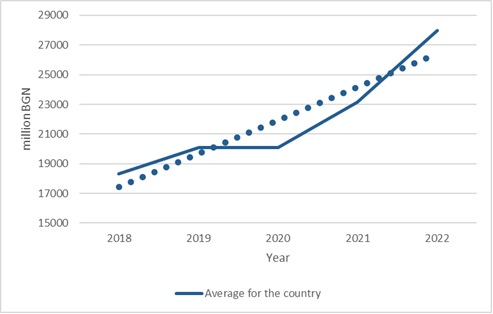
Figure 1. Dynamic of Gross domestic product in Bulgaria 2018-2022Source: National Statistical Institute
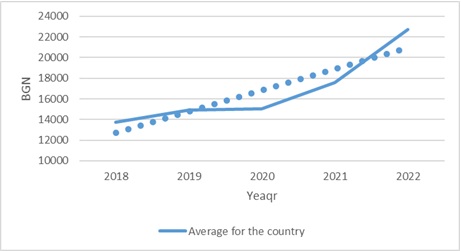
Figure 2. Dynamic of Gross domestic product per capita in Bulgaria 2018-2022Source: National Statistical InstituteAnother important macro indicator for economic potential and economic attractiveness is the accumulated volume of Foreign direct investments (FDI) which are made for the specified period (figure 3).
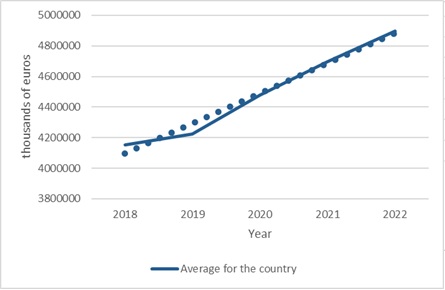
Figure 3. Dynamic of Foreign direct investments in Bulgaria 2018-2022Source: National Statistical InstituteFor the period of 5 years (2018 – 2022) foreign direct investment in the national Economy have increased with 18%. Recalculated with cumulative temp of the inflation for the period (which have been shown above and was approximately 35,9%) shows some temp of decrease of the Foreign direct investment. Based on this, we can make conclusion that Bulgarian economy lose competitiveness and attractiveness for the foreign investors. The trends in the investments (in this specific case of the FDI) will be used as a base for comparison with the implemented investments in assets of the enterprises that are operating in the sector of recycling industry.
Micro indicators analysis
According to methodological point of view the analysis will continue on level sector with aggregated data from level enterprises. The results are shown for enterprises from the sector of recycling industry by code of the economic activity from Statistical classification of economic activities in the European Community (NACE) 2008 (table 1), as shown:
Table 1. Type of economic activities related on recycling industry
| Code | Activity |
| 38.1 | Waste collection |
| 38.2 | Processing and disposal of waste |
| 38.3 | Recycling of materials |
| 38 (national average) | Collection and disposal of waste; material recycling (national average) |
| 38 (total for the region) | Collection and disposal of waste; recycling of materials (total for the region) |
Figure 4A shows the number of the enterprises of the recycling industry that are performing activity in the South-Central region. It can be seen that the enterprises that are performing activities of collecting waste are decreasing during the whole period of research, as from 57 in 2018 year their number decreased to 45 in 2022 year, which decrease is with approximately 21%. The opposite trend is seen in the activity of processing and disposal of waste. In it the increase of the enterprises is with 80% and this is during the whole period of the research, as from 20 in the beginning they become 36 in the end of the specified period. Similar trend of increase during the period from 2018 to 2021 years is seen also in the enterprises that are performing the activity of recycling materials, as their number from 26 become 31. During the last year of the researched period can be seen decrease in their number to 29. Despite the decrease compared to the starting period of the research it can be seen increase in the number of enterprises with 11,5%.
Figure 4B shows the change of the number of the enterprises of the recycling industry total for the South-Central region and average for the country. From it can be established that the number of the enterprises total for the region is staying almost the same with a little temp of increase in the end of the researched period, as the total increase for the period is 4,07%. Similar trend is seen also in the enterprises for recycling average for the country until 2020 year as in the end of the researched period are seen hesitations with incensement of their number to 117 in 2021 year and after that decrease to 107 in 2022 year. Despite the shown decrease in the end of the research period it can be seen increase from 6,80% in the considered enterprises.
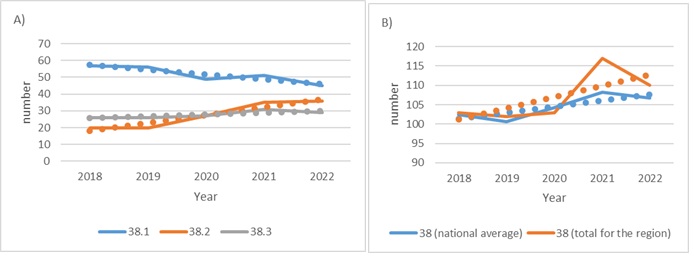
Figure 4A and 4B. Dynamic of number of enterprises 2018-2022Source: National Statistical Institute
- B) Turnover
Almost similar is the trend for the dynamic of the turnover in the enterprises average for the country and the total for the South-Central region, as the decrease of the turnover in 2020 year is typical for both of the considered groups of enterprises (figure 5B). During the period 2021 – 2022 years can be seen delay in the temp of increasement of the turnover for the researched region from 171307 to 182777 in comparison to this of average for the country from 266483 thousand BGN to 306331 thousand BGN or increase with 40,3%.
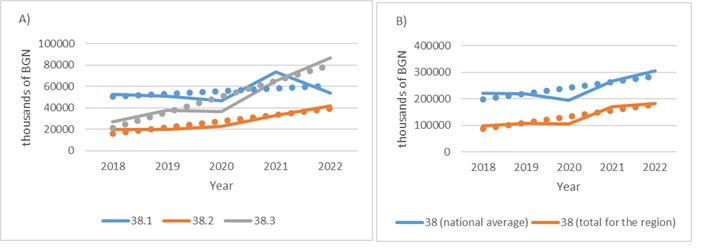
Figure 5A and 5B. Dynamic of turnover of enterprises 2018 – 2022Source: National Statistical Institute
- C) Short-term tangible assets
Comparing the value of the short-term assets value average for the country with that is total for the South-Central region (figure 6B) can be seen that the whole increase in the region is bigger than the average for the country accordingly 68,58% and 41,65%.
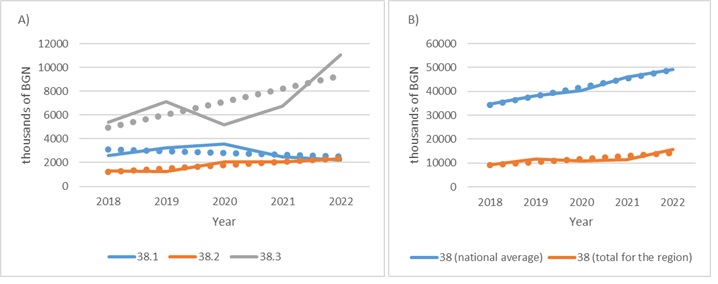
Figure 6A and 6B. Dynamic of short-term tangible assets of enterprises 2018-2022Source: National Statistical Institute
- D) Employees
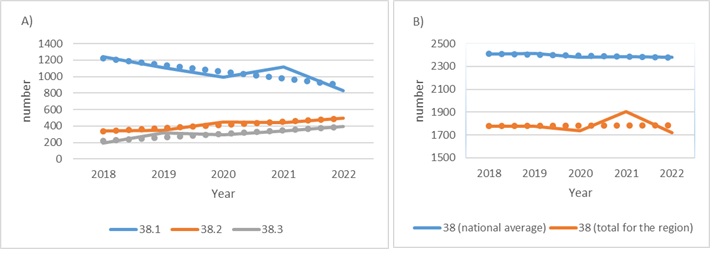
Figure 7A and 7B. Dynamic of number of employees in enterprises 2018-2022Source: National Statistical Institute
- E) Investments (long-term assets acquisition costs)
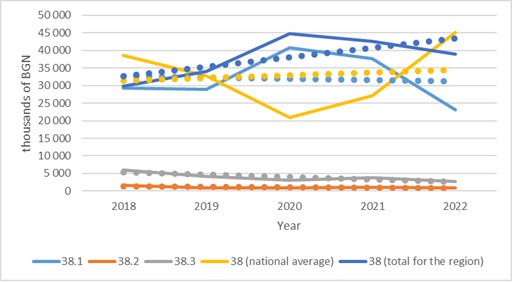
Figure 8. Investments in enterprises (Costs for the acquisition of Fixed Tangible Assets) 2018-2022Source: National Statistical Institute
- Conclusions and summaries
Acknowledgement
We acknowledge the financial support of the project “Research and Development of a Conceptual Model of an Academic Innovation-based Incubator”, №NID NI-3/0222/A, R&D Fund, University of National and World Economy, Sofia, Bulgaria.
REFERENCES
Biolcheva, P., & Valchev, E. (2023). Increasing CSR Through a Methodology for Intelligent Personal Efficiency of Employees. Strategies for Policy in Science and Education, 31(6s), 126 – 137. https://doi.org/10.53656/str2023-6s-11-inc
Costoff, D. (2020, November 4). What are the Legal Requirements for E-waste Collection and Recycling? Ecologica. https://ecologica.bg/2020/11/04/kakvi-sa-zakonovite-iziskvaniya-za-sabirane-i-retsiklirane-na-elektronni-otpadatsi/
Dimitrova, K. (2017). Innovative and Intelligent Solutions for Recycling of Household Waste in Bulgaria. Annual Journal of Technical University of Varna, 1(1), 52 – 66. https://doi.org/10.29114/ajtuv.vol1.iss1.38
Doneva, D. (2021). Еco-innovations and Resource Effectiveness. In Sustainable development and socio-economic cohesion in the 21st century - trends and challenges: Conference Proceedings: Vol. II (pp. 172 – 178). Tsenov Academic Publishing House. [in Bulgarian]
Dragozova, E. & Kovacheva, S. (2023). Research on the Sustainable Development Competences of the Landscape Architect in Practice. Strategies for Policy in Science and Education, 31(6s), 56 – 67. https://doi.org/10.53656/str2023-6s-5-res
Georgiev, I., Hutova, V., Popov, G., Andreeva, D., Yovkova, Y., Marinova, Y., Kamenov, Y., Ignatova, N., Shterev, N., Radev, R. & Blagoev, D. (2008). Economic of the enterprise. University Publishing House Stopanstvo. [in Bulgarian]
Krasteva, I. (2021). Circular Economy – Model for Increasing the Sustainability of Agriculture. In Sustainable development and socio-economic cohesion in the 21st century – trends and challenges: Conference Proceedings: Vol. II (pp. 625-631). Tsenov Academic Publishing House. [in Bulgarian]
National Statistical Institute. (2024). Methodological Notes for Calculating of GDP by Production Method. https://www.nsi.bg/sites/default/files/files/metadata/GDP_1.2.1_Methodology.pdf
NORD Holding. What are the Most Recyclable Materials? (2023, April 3). https://nordholding.bg/novini-bg/koi-sa-naj-retsikliruemite-materiali/
Sterev, N. (2023). Pre-Incubation Toolkits for Academic Entrepreneurship Fostering: Bulgarian Case. Strategies for Policy in Science and Education, 31(3s), 90 – 103. https://doi.org/10.53656/str2023-3s
Terzieva, A. (2023). Analysis of the Requirements for Storing and Storage of the Chemical Substances and Mixes. In Management in unpredictable business environment: Conference Proceedings (pp. 11 – 15). University of Chemical Technology and Metallurgy. [in Bulgarian]
Vranchev, K. (2020). Impact and Effectiveness of the Foreign Direct Investment over the Economical Growth. Annual almanac scientific researches of PhD students, 13(16), 330. [in Bulgarian]
World Trade Organization. (1996, October 9). Trade and Foreign Direct Investment Report. [Press release]. https://www.wto.org/english/news_e/pres96_e/pr057_e.htm