
A SURVEY OF ENTREPRENEURIAL BEHAVIOUR OF STUDENTS IN ECONOMICS
Lyubcho Varamezov ORCID iD: 0000-0003-1964-2786D. A. Tsenov Academy of Economics - Svishtov, Bulgaria
Iskra PanteleevaORCID iD: 0000-0002-6976-0644D. A. Tsenov Academy of Economics - Svishtov, Bulgaria
Emil NikolovORCID iD: 0000-0003-3852-9316D. A. Tsenov Academy of Economics - Svishtov, Bulgaria
https://doi.org/10.53656/igc-2024.01

Pages 22-33
Abstract. The importance of entrepreneurship for socio-economic development motivates governments to implement measures to stimulate it. Some of them are aimed at the formation of entrepreneurial attitudes and intentions of certain groups of persons. Often entrepreneurial attitudes and intentions remain latent and do not find practical manifestation. The purpose of the article is to present the results of an empirical study of the entrepreneurial behaviour of economics students. The data was generated through an online survey of 422 students from the Tsenov Academy of Economics, Svishtov, Bulgaria. Their entrepreneurial profile is outlined, and positive and negative effects are identified.
Keywords: entrepreneurial behaviour, entrepreneurship, students
JEL: A20, L26
- Introduction
The entrepreneurial behaviour of young people plays an essential role in the formation of an adequate business profile, providing a number of positives both for individuals and for the many local, social, and professional communities. On this basis, the research interest in studying the entrepreneurial behaviour of part of the young people acquiring a higher economic education was provoked. The present paper presents the results of an empirical study of the entrepreneurial behaviour of students in Economics at the Tsenov Academy of Economics, part of the comprehensive study of their entrepreneurial attitudes, intentions, and behaviour. The aim is to outline their entrepreneurial profile and identify positive and negative effects.
- Literature review
Despite the importance of entrepreneurship to economic development, the role of students in entrepreneurship development remains largely unexplored (Izedonmi & Okafor, 2010). Furthermore, opinions on whether or not entrepreneurship can be taught remain controversial (Barba-Sánchez & Atienza-Sahuquillo, 2018). However, the prevailing view is that the inclusion of entrepreneurship education in university curricula leads to an increase in entrepreneurial attitudes, intentions, and behaviour among students. A study among 300 students in Turkey (Turker & Selcuk, 2009) shows that entrepreneurship can be encouraged as a result of a learning process, and this result is interesting not only from a theoretical point of view, but also a challenge for educators and policymakers. According to Remeikiene et al. (2013) the main factors of entrepreneurial intentions are personality traits, and they can be developed at university during the learning process. However, this finding applies only to economics students, according to whom economic education not only provides useful knowledge for starting a business, but also contributes to the development of personal traits, such as self-efficacy, risk-taking, proactivity, attitude to entrepreneurship, etc. At the same time, mechanical engineering students express the opposite opinion - education does not bring useful business information to businesses and does not encourage the creativity of young people to start a business. Liu et al. (2019), based on a survey of 327 students, concluded that entrepreneurship education had a significant positive effect on their entrepreneurial intention, and research by Cui (2021) found that entrepreneurship education in universities had a direct impact on entrepreneurial behaviour. Ho et al. (2014) used data from a survey of 836 students at the National University of Singapore to examine the relationship between university entrepreneurship education programs and students' entrepreneurial intentions and behaviours. According to the authors, entrepreneurial intentions can be stimulated through education, and university education in entrepreneurship promotes students' entrepreneurial behaviour. An important finding of the study is that experiential learning has a significantly greater impact on entrepreneurial engagement than classroom learning.
Izedonmi & Okafor (2010) collected data from 250 students from various universities whose curricula included an entrepreneurship course. The results of the study show that entrepreneurship education has a positive influence on students' entrepreneurial intentions. According to the authors, education provides the necessary knowledge and skills that can transform students' entrepreneurial intentions into entrepreneurial behaviour. Moreover, starting entrepreneurship among students not only improves their economic lifestyle, but also leads to the emergence and spread of entrepreneurial spirit within universities. The results of Luo et al. (2022) study of 1,100 Chinese students showed that entrepreneurship education improved students' ability to identify and integrate social resources and played a moderating role between the entrepreneurial environment and entrepreneurial self-efficacy (the level of confidence that entrepreneurs can accomplish various entrepreneurial tasks). Barba-Sánchez & Atienza-Sahuquillo (2018) conducted an empirical study among 423 engineering students and found that entrepreneurship education had a positive impact on students' entrepreneurial intentions.
Although entrepreneurship education is one of the key tools to increase students' entrepreneurial attitudes, intentions and behaviour, the factors that determine an individual's decision to start their own business are still not fully understood (Liñán et al. 2011). Investigating the causes of entrepreneurial intentions among engineering students, Lüthje & Franke (2003) concluded that personality traits strongly influence entrepreneurial attitudes, and entrepreneurial attitudes are closely related to entrepreneurial intentions. It follows that personality traits, albeit indirectly, influence entrepreneurial intentions. According to Van Gelderen et al. (2008) students' entrepreneurial intentions and therefore their propensity for entrepreneurial behaviour are shaped by their attitudes towards entrepreneurship. Entrepreneurial intentions function as a mechanism that triggers self-employment decisions, i.e. entrepreneurial intentions are an important predictor of an individual's entrepreneurial behaviour (Santos et al., 2021). These and other studies (Adeel et al., 2023; González et al., 2022; Neneh, 2019; Yordanov, 2023; Sterev et al., 2023; Sterev, 2023) prove a positive and significant influence of entrepreneurial intention on entrepreneurial behaviour. According to Zhang et al. (2015) study of college students' entrepreneurial intentions can improve our understanding of their potential entrepreneurial behaviour. At the same time, Cui (2021) states that although studies support the intention-behaviour relationship, the predictive power of intentions is relatively weak in the context of entrepreneurship.
Barba-Sánchez & Atienza-Sahuquillo (2018) point out three factors influencing entrepreneurial intentions. They call the first factor “Be independent”, highly saturated with the elements “Feel satisfied with my job” and “Be my own boss”. The second factor (“Financial Motivation”) focuses on the items “Have job stability”, “Be financially secure” and “Earn a lot of money”. And the third factor (“Need for Achievement”) is related to the items “Be the best at everything I do” and “Develop professionally and personally”. The role played by personality characteristics on entrepreneurial intentions and the resulting entrepreneurial behaviour was investigated by Niţu-Antonie & Feder (2015). The analysis was performed on a group of students (bachelor's and master's) in economics and shows that behavioural characteristics appear as significant predictors of entrepreneurial intentions, and they, in turn, are a primary forecaster of real entrepreneurial activity. Mensah et al. (2021) investigated the factors influencing students' intention to engage in entrepreneurial activities (entrepreneurial behaviour). The results show that entrepreneurial attitude, subjective norm, and perceived behavioural control were all significant in determining college students' entrepreneurial intentions. Entrepreneurial self-efficacy, entrepreneurial education, and student internship motivation were also positive and significant predictors of college students' entrepreneurial intention. According to research by Lihua (2022) attitude, subjective norms, perceived behaviour control, and entrepreneurial situational factors have significant impacts on the formation of college students' entrepreneurial intention, while entrepreneurial intention, perceived behaviour control, and entrepreneurial situational factors have significant impacts on the transformation phase of entrepreneurial behaviour. The factors influencing students' entrepreneurial intentions are complex, but the main ones are personality traits such as self-efficacy, risk-taking, initiative to start a business, favourable attitude towards business, behavioural control, need for achievement and internal locus of control, and can develop through education (Remeikiene et al., 2013). Key determinants of entrepreneurial behaviour among Chinese students are various internal and external factors such as self-efficacy, entrepreneurial intentions, and entrepreneurial education (Wang & Sahid, 2024).
- Methodology
Table 1. Profile of respondents who answered that they own their own business
| Characteristic | Category | Number | Share |
| Gender
(n = 102) | Men
Women | 71
31 | 69.61%
30.39% |
| Age[1]
(n = 101) | From 20 to 30 years
From 31 to 40 years From 41 to 50 years From 51 to 61 years | 45
34 20 2 | 44.56%
33.66% 19.80% 1.98% |
| Course\Year
(n = 102) | First
Second Third Fourth | 28
36 5 33 | 27.45%
35.29% 4.17% 32.35% |
Data analysis was carried out with the help of Microsoft Excel and SPSS software. Quantitative indicators (average scores, ranks, shares, standard deviation, minimum and maximum values) and visual tools (tables and diagrams) were used to formulate inferences and conclusions.
- Results and discussion
One of the first decisions that entrepreneurs have to make when starting their own business is related to choosing the appropriate legal form for the particular business. In view of the advantages that the limited liability company has, it is no surprise that 71.00% of the surveyed students chose this particular form to start their business. In second place is the sole trader, which is characterized by low registration costs and the possibility of keeping simplified accounting. These two forms account for 95.00% of all cases. Although the majority of entrepreneurs (81.40%) carry out their activities independently, their opinion about starting a business in a partnership is rather positive. Using a positive 5-point Likert scale, the average score for starting a business in a partnership is 3.90 (see Table 2).
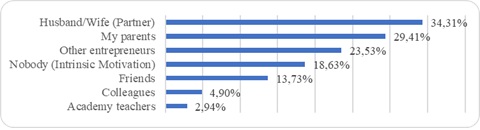
Figure 1. Individuals positively influencing the decision to start a business (% of respondents who indicated this answer)Their attitude towards Bulgarian entrepreneurs is also weakly positive (3.30), and the assessment of the business environment is slightly negative (2.79).
Table 2. Descriptive statistics
| N | Min. | Max. | Mean | Std. Dev. | |
| Starting a business in partnership is a good idea: | 102 | 1,00 | 5,00 | 3,90 | 0,98010 |
| Your opinion about entrepreneurs in Bulgaria is: | 102 | 1,00 | 5,00 | 3,30 | 1,31095 |
| In your opinion, the business environment in Bulgaria is: | 102 | 1,00 | 5,00 | 2,79 | 1,14614 |
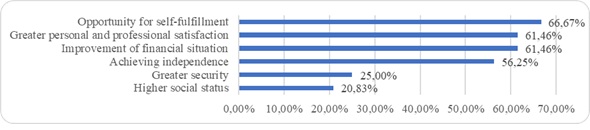
Figure 2. Positives of entrepreneurship (% of respondents who indicated this answer)In addition to positive effects, entrepreneurship also has negative manifestations. Among them, the most tangible are the lack of free time, high levels of stress and work overload (see Fig. 3). They arise from the full dedication inherent in entrepreneurs to the realization of the idea, as well as from taking full responsibility for the success or failure of the venture. Entrepreneurship is also about taking risks, and this inevitably affects the entrepreneur's stress levels.

Figure 3. Negatives of Entrepreneurship (% of respondents who indicated this answer)For a small part of the respondents, entrepreneurship also led to a bad financial situation. This can be the result of the need to invest one's own financial means in the development of the idea, the inherent work at a loss at the beginning when the customers are not yet enough to cover the costs, or due to a loss that is the result of other factors - hyper-competition, inefficiency, poor financial management, etc.
The main focal points for discussion are in several directions:
– Dominant share of students with a positive attitude towards entrepreneurship, providing opportunities for forming a suitable egregor and a favourable environment for increasing motivation, intensifying educational processes, and increasing the critical mass of students with good entrepreneurial knowledge and skills.
– A significant share of students with demonstrated entrepreneurial behaviour, which helps to increase the quality of acquired knowledge, tested in a real business environment.
– Profile of students with demonstrated entrepreneurial behaviour, conducive to the creation of additional positives, as a result of communication processes and interactions between students with a positive attitude, positive intentions, and entrepreneurial behaviour.
– Positive youth entrepreneurial activity, combined with student status, favouring the realization of additional cash flows and additional contribution to the tax-insurance system and GDP of the country.
- Conclusion
REFERENCES
Adeel, S., Daniel, A. D., & Botelho, A. (2023). The Effect of Entrepreneurship Education on the Determinants of Entrepreneurial Behaviour among Higher Education Students: A Multi-group Analysis. Journal of Innovation & Knowledge, 8(1), 100324. https://doi.org/10.1016/j.jik.2023.100324
Amway Entrepreneurial Spirit Index (AESI). (2023). AGER Global entrepreneurship report: Entrepreneurship’s new normal. https://www.amwayglobal.com/wp-content/uploads/2023/08/AGER-FinalReport-2023-2-LowRes.pdf
Amway Entrepreneurial Spirit Index (AESI). (2015). AGER Global entrepreneurship report: Defining the entrepreneurial spirit. https://www.amwayglobal.com/wp-content/uploads/2017/09/ager_2015_report.pdf
Barba-Sánchez, V., & Atienza-Sahuquillo, C. (2018). Entrepreneurial Intention among Engineering Students: The Role of Entrepreneurship Education. European research on management and business economics, 24(1), 53 – 61. https://doi.org/10.1016/j.iedeen.2017.04.001
Bartlett, J., Kotrlik, J., & Higgins, C. (2001). Organizational Research: Determining Appropriate Sample Size in Survey Research. Information Technology, Learning, and Performance Journal, 19(1), 43– 50.
Cardella, G. M., Hernández-Sánchez, B. R., & Sánchez García, J. C. (2020). Entrepreneurship and Family Role: A Systematic Review of a Growing Research. Frontiers in psychology, 10, 2939. https://doi.org/10.3389/fpsyg.2019.02939
Cui, J. (2021). The Influence of Entrepreneurial Education and Psychological Capital on Entrepreneurial Behavior among College Students. Frontiers in Psychology, 12, 755479. https://doi.org/10.3389/fpsyg.2021.755479
González, J. A. del B., Aranda, M. M., & Barba-Sánchez, V. (2022). Environmental Awareness and the Entrepreneurial Intention in University Students: Direct and Mediating Effects. The International Journal of Management Education, 20, 100719. https://doi.org/10.1016/j.ijme.2022.100719
Ho, Y.-P., Low, P.-C. & Wong, P.-K. (2014). Do University Entrepreneurship Programs Influence Students’ Entrepreneurial Behavior? An Empirical Analysis of University Students in Singapore. In Innovative Pathways for University Entrepreneurship in the 21st Century (Advances in the Study of Entrepreneurship, Innovation and Economic Growth, Vol. 24) (pp. 65 – 87). Emerald Group Publishing. https://doi.org/10.1108/S1048-473620140000024003
Izedonmi, P. F., & Okafor, C. (2010). The Effect of Entrepreneurship Education on Students’ Entrepreneurial Intentions. Global journal of management and business research, 10(6), 49 – 60. https://core.ac.uk/download/pdf/18294966.pdf
Koe, W. L. (2016). The Relationship between Individual Entrepreneurial Orientation (IEO) and Entrepreneurial Intention. Journal of Global Entrepreneurship Research, 6, 1 – 11. https://doi.org/10.1186/s40497-016-0057-8
Lihua, D. (2022). An Extended Model of the Theory of Planned Behavior: An Empirical Study of Entrepreneurial Intention and Entrepreneurial Behavior in College Students. Frontiers in psychology, 12, 627818. https://doi.org/10.3389/fpsyg.2021.627818
Liñán, F., Rodríguez-Cohard, J. C., & Rueda-Cantuche, J. M. (2011). Factors aAfecting Entrepreneurial Intention Levels: A Role for Education. International entrepreneurship and management Journal, 7, 195 – 218. https://doi.org/10.1007/s11365-010-0154-z
Liu, X., Lin, C., Zhao, G., & Zhao, D. (2019). Research on the Effects of Entrepreneurial Education and Entrepreneurial Self-efficacy on College students’ Entrepreneurial Intention. Frontiers in psychology, 10, 869. https://doi.org/10.3389/fpsyg.2019.00869
Luo, L., Guo, M., Huang, J., & Yang, J. (2022). Research on the Effect of an Entrepreneurial Environment on College students’ Entrepreneurial Self-efficacy: The Mediating Effect of Entrepreneurial Competence and Moderating Effect of Entrepreneurial Education. Sustainability, 14(11), 6744. https://doi.org/10.3390/su14116744
Lüthje, C., Franke, D. (2003). The ‘making’ of an Entrepreneur: Testing a Model of Entrepreneurial Intent Among Engineering Students at MIT. R&D Management, 33, 135 – 147. https://doi.org/10.1111/1467-9310.00288
Meng, D., Shang, Y., Zhang, X., & Li, Y. (2023). Does Entrepreneurship Policy Encourage College Graduates’ Entrepreneurship Behavior: The Intermediary Role Based on Entrepreneurship Willingness. Sustainability, 15(12), 9492. https://doi.org/10.3390/su15129492
Mensah, I. K., Zeng, G., Luo, C., Xiao, Z., & Lu, M. (2021). Exploring the Predictors of Chinese College Students’ Entrepreneurial Intention. Sage Open, 11(3). https://doi.org/10.1177/21582440211029941
Neneh, B. N. (2019). From Entrepreneurial Alertness to Entrepreneurial Behavior: The Role of Trait Competitiveness and Proactive Personality. Personality and Individual Differences, 138, 273 – 279. https://doi.org/10.1016/j.paid.2018.10.020
Niţu-Antonie, R. D., & Feder, E. S. (2015). The Role of Economic Academic Education on Entrepreneurial Behaviour. Amfiteatru Economic Journal, 17(38), 261 – 276. https://www.econstor.eu/bitstream/10419/168915/1/aej-v17-i38-p0261.pdf
Remeikiene, R., Startiene, G., & Dumciuviene, D. (2013). Explaining Entrepreneurial Intention of University Students: The Role of Entrepreneurial Education. In V. Dermol, N. T. Širca, G. Đaković (Eds.), Active Citizenship by Knowledge Management & Innovation: Proceedings of the Management, Knowledge and Learning International Conference (pp. 299 – 307). ToKnowPress.
Santos, S. C., Neumeyer, X., Caetano, A., & Liñán, F. (2021). Understanding How and When Personal Values Foster Entrepreneurial Behavior: A Humane Perspective. Journal of Small Business Management, 59(3), 373 – 396. https://doi.org/10.1080/00472778.2021.1888384
Sterev, N. (2023). Pre-Incubation Toolkits for Academic Entrepreneurship Fostering: Bulgarian Case. Strategies for policy in science and education, 31(3s), 90 – 103. https://doi.org/10.53656/str2023-3s-7-pre
Sterev, N., Kostadinov, K., Yordanov, D. & Yorgova, T. (2023). Open Entrepreneurial Academic Centres. Economic Studies journal, 4, 116 – 113. https://www.iki.bas.bg/Journals/EconomicStudies/2023/2023-4/08_Nikolay-Sterev.pdf
Turker, D., & Selcuk, S. S. (2009). Which Factors Affect Entrepreneurial Intention of University Students? Journal of European industrial training, 33(2), 142 – 159. https://doi.org/10.1108/03090590910939049
Van Gelderen, M., Brand, M., Van Praag, M., Bodewes, W., Poutsma, E., & Van Gils, A. (2008). Explaining Entrepreneurial Intentions by Means of the Theory of Planned Behavior. Career Development International, 13(6), 538 – 559. https://doi.org/10.1108/13620430810901688
Wang, F., & Sahid, S. (2024). A Systematic Review of the Entrepreneurial Behavior among College Students in China. International Journal of Learning, Teaching and Educational Research, 23(7), 167 – 185. https://doi.org/10.26803/ijlter.23.7.9
Yordanov, D. (2023). Toolkit for Assessing Entrepreneurial Competencies among Learners. Strategies for Policy in Science and Education, 31(3s), 25-44. https://doi.org/10.53656/str2023-3s-2-too
Zhang, P., Wang, D. D., & Owen, C. L. (2015). A Study of Entrepreneurial Intention of University Students. Entrepreneurship Research Journal, 5(1), 61 – 82. https://doi.org/10.1515/erj-2014-0004