
Науката за образованието: теория и практика
THE EFFECT OF HYDROCOLLOIDS CONCENTRATION ON THE PHYSICAL PROPERTIES OF GLUTEN-FREE CAKE
Резюме. In the present study the influence of hydrocolloids addition at different concentration (0.45, 0.9 and 1.5 %) to gluten-free cakes was studies and the quality of cakes was investigated. Based on investigation results it was found that, with the addition of xanthan – guar gum blend at concentrations 1.5 % (50:50 ratio) to the rice flour favorable results were achieved, represented by increased specific volume, lower loss of weight and decreased hardness of the products if compared to the control. The results from the sensory test indicated that all of the sample formulations produced high consumer acceptance rating (x>6). Additionally the use of xanthan – guar gum blend (1.5 %) as well as xanthan gum (0.9 %) showed a trend to retard the staling of rice cakes in the interval between 24 and 96 hour of the storage. The enthalpy values of cakes with hydrocolloids added were lower than the control sample for the whole period of 140 h of storage.
Ключови думи: hydrocolloids; gluten-free cake; quality; staling; sensory analysis
Physics is an ever young science, Varna, October, 27 – 29, 2017
Физиката – вечно млада наука, Варна, 27 – 29 октомври 2017 г.
Introduction
Aside from the portion of the population that requires a gluten-free diet due to celiac disease or wheat allergies, there is also an increasing sector that chooses a gluten-free diet because they believe doing so will improve their overall health and well being (Engleson & Atwell, 2008). Rice flour is one of the most suitable cereal flours for preparing gluten-free products due to its several significant properties such as natural, colourless and bland taste. In addition, it has also hypoallergenic proteins, and low content of sodium and fat and high amount of easily digested carbohydrates (Gujral & Rosell, 2004). The relatively small amount of prolamin in rice, forces to use some sort of gum, emulsifier, enzymes or dairy products, together with rice flour, for obtaining some viscoelastic properties (Demirkesen et al., 2010). In order to mimic viscoelasticity, provided by the gluten proteins, the addition of hydrocolloids or gums, to the gluten free formulation is critical. The effects of their addition to bakery products include: altered batter rheological performance, improved sensory properties, increased loaf volume, retarded starch retrogradation, and increased moisture retention. Hence, their use extends overall quality of the product over time (Anton & Artfield, 2008; Collar et al., 1999; Davidou et al., 1996; Rojas et al., 1999). The most commonly used hydrocolloids in gluten free bread formulations are cellulose, hydroxypropylmethylcellulose (HPMC), pectin, guar gum, xanthan gum and locust bean gum (Onyango et al., 2009; Turabi et al., 2010).
The general objective of this study is to determine the influence of hydrocolloids (xanthan gum, guar gum and xanthan – guar gum blend) concentration on the quality of rice cake.
Materials and methodology
Materials – rice flour (14% moisture, 6.1% protein content (N×5.95), 0.6% ash), eggs, sucrose, baking powder (Dr. Öetker) and shortening (Becel, Unilever) were all purchased from the local supermarket. Xanthan gum and guar gum were delivered by “Analitica” Ltd, Plovdiv, Bulgaria.
Methods – cake batter formulation contained: 31% rice flour, 24% sucrose, 20% shortening, 24% eggs and 1% baking powder. The gums (xanthan gum, guar gum) were added to the batter formulation at concentrations of 0.45, 0.9, 1.5% (on flour weight basis) and the blend of gums was consisted of equal parts of both gums (0.5% xanthan gum + 0.5% guar gum). Sample with no hydrocolloids added represented the control cake. The batter samples of 450 g were baked at 180 0C for 37 min in a commercial oven. After baking the cakes cooled down for 2 h and then placed in plastic bags and stored at room temperature at different storage times (0, 24, 48, 72, 96, 120 and 140 h). Percent weight loss of cakes during baking was calculated by using the mass of cake batter and mass of cake sample after baking. Specific volume of the cakes was determined by the rape seed displacement method. 1) Texture profile parameter of “hardness” was measured by using texture analyzer (StableMicroSystems TA-XT2Plus). Crumb hardness (N) of cake samples was measured during storage at any given time. Consumer acceptance test was performed using 9-point hedonic scale on the freshly baked cakes as well as during the storage (Resurreccion, 2008). Differential Scanning Calorimetry (DSC) Analysis (DSC 204 F1 Phoenix NETZSCH-Gerätebau GmbH, Germany) was used to study the starch retrogradation during storage. The gluten contamination analysis was performed by a gluten assay kit (SureFood® ALLERGEN ID Gluten S3106). Analysis of variance (ANOVA) was used to determine whether there was a statistically significant effect of storage periods, gum types and concentrations (p≤0.05). Variable means were compared by Duncan’s test by using statistical program. 2)
Experiments and discussion
The effect of different gum types and gum concentrations on the rice cake quality parameters
The effect of different gum types and gum concentrations on weight loss of the cake samples are presented on Fig. 1. The different gum concentrations were chosen based on the literature results (Sumnu et al., 2010).
The control sample exhibits the highest loss of weight. The lowest loss of weight was demonstrated by the sample with the gum blend and the sample with xanthan 0.9%. The samples containing xanthan gum showed lower loss of weight values if compared to the samples with guar gum. The addition of guar gum resulted in samples significantly different either within the same group or the control as well as the rest of the samples. (p≤ 0.05).
The effect of different gum types and gum concentrations on specific volume of the cake samples are presented in Fig. 2.
The samples containing xanthan gum ≥ 0.9% exhibited higher specific volume if compared to the samples with guar 0.45 and 1.5%. (p≤ 0.05). The rice cake with 1.5% gum blend demonstrated the best specific volume what can be explained with the influence of xanthan gum on the viscosity of the batter.
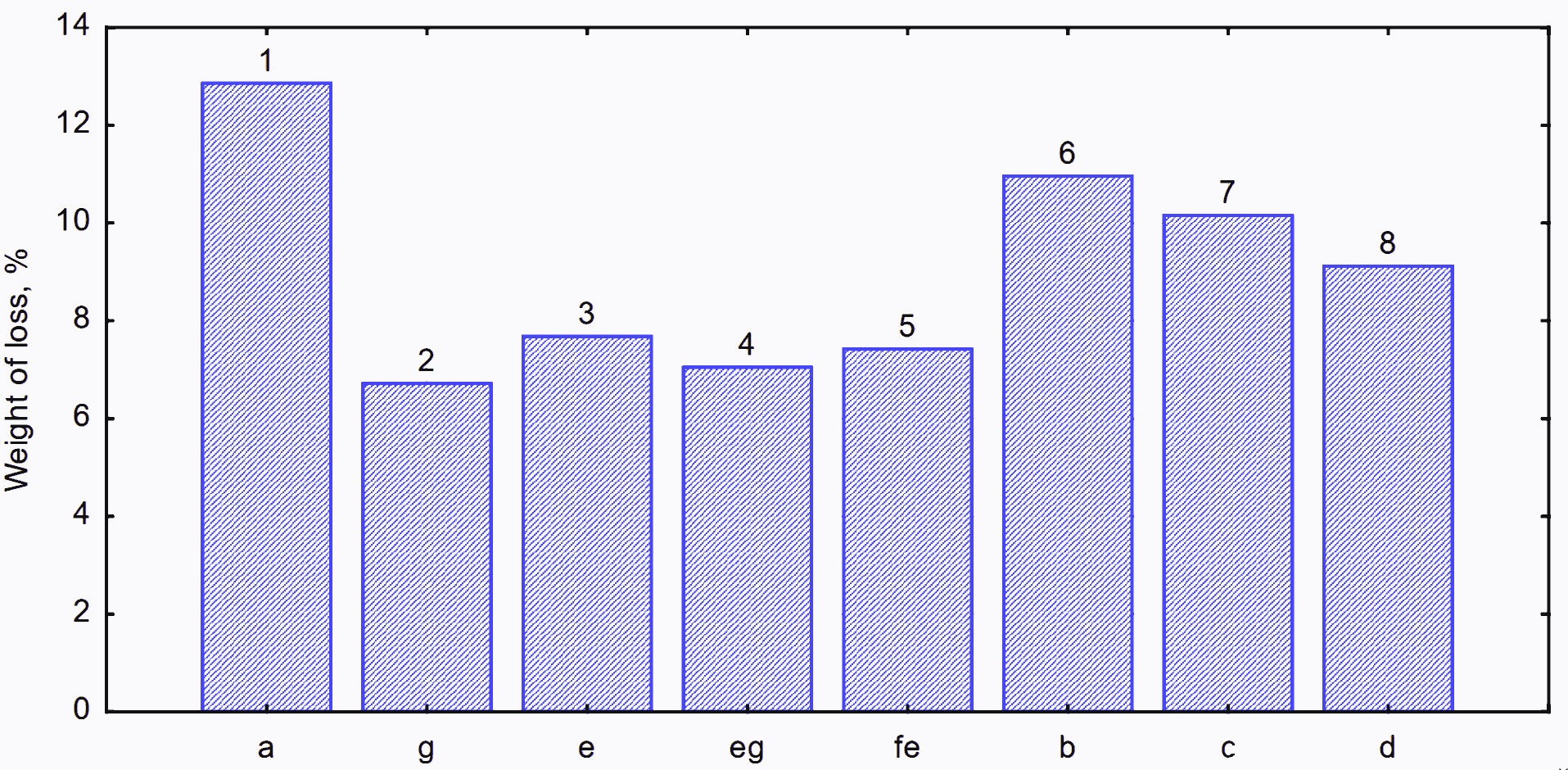
Figure 1. Effect of gums added at different concentrations on the weight loss of rice cake during baking: control (1); sample with gum blend 50:50% (2); sample with xhantan 0.45% (3); sample with xhantan 0.9% (4); sample with xhantan 1.5% (5); sample with guar 0.45% (6); sample with guar 0.9% (7); sample with guar 1.5% (8). (means with different letters are significantly different)
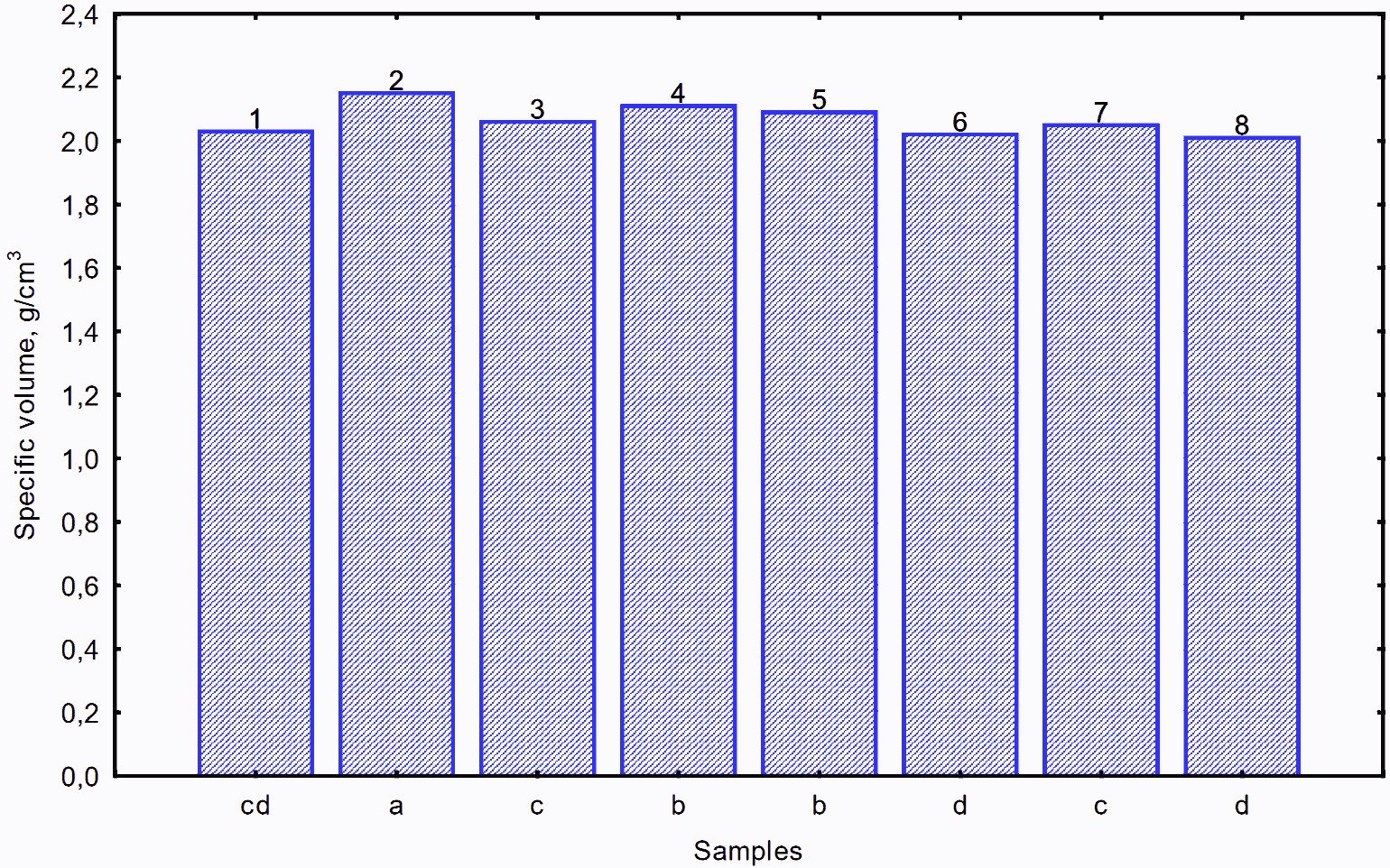
Figure 2. Effect of gums added at different concentrations on the specific volume of rice cake: control (1); sample with gum blend 50:50% (2); sample with xhantan 0.45% (3); sample with xhantan 0.9% (4); sample with xhantan 1.5% (5); sample with guar 0.45% (6); sample with guar 0.9% (7); sample with guar 1.5% (8). (means with different letters are significantly different)
The effect of different gum types and gum concentrations on hardness of the cake samples are presented on Fig. 3. a
Figure 3. Effect of gums added at different concentrations on the hardness of rice cake: control (1); sample with gum blend 50:50% (2); sample with xhantan 0.45% (3); sample with xhantan 0.9% (4); sample with xhantan 1.5% (5); sample with guar 0.45% (6); sample with guar 0.9% (7); sample with guar 1.5% (8). (means with different letters are significantly different)
The sample with the gum blend addition (1.5%) showed the lowest hardness followed closely by the sample with xanthan (1.5%), (p<0.05). The product with the highest concentration of guar gum was the hardest. (p<0.05). Overall the cakes with guar gum at selected concentrations demonstrated pattern of increased hardness with the increase of the amount used. On the contrary, with the addition of xanthan gum the hardness of the samples decreased in value. All of the samples were significantly difference from the control. (p<0.05).
A consumer acceptance test was conducted in the sensory laboratory at the Food Research and Development Institute. A panel of consumers (N=30) was recruited according to demographic surveys about confectionary consumption patterns and age/gender groups from an existing consumer database. Participants were between 18 and 64 years of age; have no allergies toward rice flour, sucrose, margarine, eggs, baking powder, guar gum and xanthan gum; and be available and willing to participate in the testing sessions. Consumers rated on appearance, color, texture, flavor, sweetness, aftertaste and overall liking of each sample seven in total and control using a 9-point hedonic scale (Peryam & Pilgrim, 1957) with 1=dislike extremely and 9=like extremely. All the samples and the control were rated “like slightly” (х≥6) on the selected sensory attributes (p=0.05). The samples with the gum blend and the sample with xanthan 0.9% had the highest ratings on all the sensory characteristics (“like very much”, p=0.05).(data not presented)
The effect of different gum types, gum concentrations and storage times on the rice cake quality parameters
The best performing samples (based on the best results on the quality parameters: weight loss, specific volume and hardness) and the control were measured.
The effect of different gum types and gum concentrations on the hardness of the cake sample with the gum blend, samples with xanthan 0.9% and control during storage are presented on Fig. 4.
Figure 4. Effect of gums added at different concentrations on the hardness of rice cake during storage: control (1); sample with gum blend 1.5% (2); sample with xanthan 0.9% (3)
As the storage time increased the hardness of the samples also increased until the forth day (96 h) was observed that the samples with xanthan 0.9% and the gum blend retarded the staling process with 1 to 2 days if compared to the control (Fig. 5). In general, the samples tested were characterized by lower hardness values than the control over the entire shelf life of the products.
Overall the samples evaluated demonstrated like a pattern lower values of hardness during the entire storage period (140 h).
Figure 5. The influence of gums added at different concentrations (sample with gum blend 1.5% and sample with xanthan 0.9%) on the hardness of rice cake during storage: common trend (p<0.05).
The retrogradation enthalpies of the selected cake samples and the control stored for 24, 96, 120 and 140 h are presented on Fig. 6.
Figure 6. Effect of gums and storage times on retrogradation enthalpies of rice cakes
It can be seen that the enthalpy of retrogradation increased with the storage time and it slowed down in the interval between 24 and 96 h if compare to the control. Overall the enthalpy values of cakes with hydrocolloids added were lower than the control sample for the whole period of 140 h of storage. Therefore, the gum blend and 0.9% xanthan gum addition in the rice cake reduced retrogradation entalphy, e.g. the amylopectin retrogradation was retarded.
Conclusion
It has been found that the parameters of quality /loss of weight, specific volume and hardness/ depend on the type and concentration of the added hydrocolloids. The combination of xanthan gum and guar gum resulted in products with increased specific volume, reduced weight loss and hardness compared to the control. In terms of sensory evaluation, all the samples and the control, were well accepted by consumers with a score of ≥ 6, but the highest values for all sensory attributes were obtained for the combination of gums as well the xanthan sample 0.9%.
During sample storage, again, the gum combination resulted in decreased loss of weight if compared to the control. Using gums at higher concentrations results in lower loss of weight and lower entalpy retrogradation values, which means retarded aging.
Increasing the hardness of the products during storage depends on the type of hydrocolloids used. The lowest values are observed for products with 0.9% xanthan added and the combination of gums as well. It has been found that adding a combination of xanthan and guar gum greatly improves quality and slows down aging in rice cakes and can therefore be recommended as the most suitable hydrocolloid for incorporation in the batter.
NOTES
1. AACC Method 10-05.01. International Approved Methods. Baking Quality. Guidelines for Measurement of Volume by Rapeseed Displacement. ISBN 9781-891127-68-2.
2. SAS Institute Inc. (2012 – 2016). Cary, NC, USA.
REFERENCES
Anton, A.A. & Artfield, S.D. (2008). Hydrocolloids in gluten-free breads: a review. Int. J. Food Sci. & Nutr., 59, 11 – 23.
Collar, C., Andreu, P., Martínez, J.C. & Armero, E. (1999). Optimization of hydrocolloid addition to improve wheat bread dough functionality: a response surface methodology study. Food Hydrocolloids, 13, 467 – 475.
Davidou, S., Le Meste, M., Debever, E. & Bekaert, D. (1996). Acontribution to the study of staling of white bread: effect of water and hydrocolloid. Food Hydrocolloids, 10, 375 – 383.
Demirkesen, T., Mert, B., Sumnu, G. & Sahin, S. (2010). Rheological properties of gluten-free bread formulation. J. Food Eng., 96, 295 – 303.
Engleson, J. & Atwell, B. (2008). Gluten-free Product Development. Cereal Foods World, 53, 180 – 184.
Gujaral, H.S. & Rosell, C.M. (2004). Improvement of breadmaking quality of rice flour by glucose oxidase. Food Res. Int., 37, 75 – 81.
Onyango, C., Mutunge, C., Unbehend, G. & Lindhauer, M.G. (2011). Modification of gluten-free sorghum batter and bread using maize, potato, cassava or rice starch. LWT-Food Sci. & Tech., 44, 681 – 686.
Peryam, D.R. & Pilgrim, F.J. (1957). Hedonic scale method of measuring food preference. Food Tech., 11, 9 – 14 (Suppl.).
Resurreccion, A.V. (1998). Consumer sensory testing for product development. Gaithersburg: Aspen..
Rojas, J.A., Rosell, C.M. & De Barber, C.B. (1999). Pasting properties of different flour-hydrocolloid system. Food Hydrocolloids, 13, 27 – 33.
Sumnu, G., Koksel, F., Sahin, S., Basman, A. & Meda, V. (2010). The effects of xanthan and guar gums on staling of gluten-free rice cakes baked in different ovens. Int. J. Food Sci. &Tech., 45, 87 – 93.
Turabi, E., Sumnu, G. & Sahin, S. (2008). Rheological properties abd quality of rice cakes formulated with different gums and emulsifier blend. Food Hydrocoolids, 22, 305 – 312.