
Методика и опит
RECONSTRUCTING THE MATHEMATICS CURRICULUM FOR POST-16 STUDENTS: A COMPARISON OF THE APPROACHES IN ENGLAND AND BULGARIA
https://doi.org/10.53656/voc22-401reco
Резюме. A major reform of the Mathematics curriculum was published in England in 2016, implemented in 2017 and examined in 2019. In Bulgaria, the analogous reform was published in 2018, will be implemented in 2020 and examined in 2022.
This paper takes the framework developed by Budgell and Kunchev (2019) and seeks to interpret the new curricula in terms of the Students, the State and the Curriculum with an introduction to Assessment.
In terms of the Curriculum, the paper examines, at the highest level, General and Specific Objectives; followed by Overarching Themes; then the Topics covered and finally the Detailed Content Statements for each topic.
The paper concludes that the real differences between the teaching of Mathematics in England and Bulgaria lie not in the Mathematics itself but in the overall curriculum and assessment frameworks within which Mathematics is taught.
Ключови думи: reform; Mathematics curriculum; England; Bulgaria; new curricula; students; assessment; general and specific objectives; overarching themes; topics; detailed content statements
The Context
If, in 2016, you were a mythical visitor from outer space, who happened to be a bilingual mathematician, and you found yourself in either an ‘Algebra and functions’ lesson or an ‘Exponentials and logarithms’ lesson in Year 13 (En) or Klas 12 (Bg), you would probably have concluded that the Mathematics curricula in England and Bulgaria are essentially similar.
A few simple enquiries would have informed you that in both countries two levels of Mathematics were taught: Mathematics and Higher Mathematics in England and General Mathematics and Profile Mathematics in Bulgaria. This structure, illustrated in Table 1, would have reinforced the conclusion that the Mathematics curricula were similar.
Table 1
Since then, however, both countries have engaged in a major reform of the Mathematics curriculum. In England, a new Mathematics curriculum was introduced in 2017 and examined for the first time in 2019; whilst in Bulgaria, the new Mathematics curriculum will be introduced in 2020 and examined for the first time in 2022.
The purpose of this paper is to examine in greater depth the similarities and differences in the Mathematic curricula in England and Bulgaria.
The Framework
Budgell and Kunchev (2019) proposed that:
a. a well-understood set of sentences (axioms), basic concepts/terms; and
b. the rules of logic must be assumed in any discussion of the education system. They propose
1. The Fundamental Axioms – Students and Education;
2. The Structural Axioms – The State and Schools;
3. The Functional Axioms – Subsidiarity, Leadership and Management, the Curriculum, Teachers, Assessment and Inspection and Inspection.
This paper (Part 1) will focus on The Students, The State and The Curriculum with an introduction to Assessment; Part 2 will address Teaching and Assessment after the new curriculum and examinations have been introduced in Bulgaria
The Students
In England, the majority of students enter a comprehensive secondary school (there are also a small number of state grammar schools and independent private schools) at the age of 11. All students study Mathematics until the age of 16; at the age of 16 students have a free choice of the 3 or 4 subjects that they wish to study. There are neither compulsory subjects nor compulsory examinations – except that you can only study Higher Mathematics if you have chosen to study Mathematics.
In Bulgaria, there is a common curriculum until the age of 14; at the age of 14 they can enter a Profile-oriented school, a comprehensive school or a vocational/ technical school. Students wishing to enter a Profile-oriented school must perform very well in entrance examinations taken at the age of 14. There is a unified curriculum, but in the last two years of study, students are required to take advanced courses in two or three subjects. Once they have entered a profile (pathway) students have little choice of what they study for 5 years.
In 2019, there were almost 600,000 18-year-olds in England of whom over 91,895 (15.6%) took A Level Mathematics and over 14,527 (2.5%) took Higher Mathematics. In Bulgaria, there were over 60,000 19-year-olds but only 2,200 (3.5%) took the Mathematics Matura as their second subject.
Nevertheless, the students studying Profile Mathematics in Bulgaria or Mathematics/Higher Mathematics in England are amongst the most academically gifted students in their respective countries. In England, those students wishing to study Mathematics after the age of 16 need to have been very successful in the Mathematics examinations (General Certificate of Secondary Education) taken at the age of 16. In Bulgaria, those students wishing to enter a Mathematics Profile-oriented school must similarly have done very well in the 14+ examinations
The State
There are two levels at which the state is involved in planning and organising the curriculum in England and Bulgaria:
– determining the structure and organisation of the curriculum framework that will provide students with the opportunity to choose the subjects that they which to study as they mature;
and because the curriculum for older students is driven by external qualifications,
– specifying, in detail, the content and assessment requirements of all subjects taught in schools.
In England, the curriculum is specified by the Qualifications and Curriculum Authority, a non-ministerial department that reports directly to Parliament – not to The Department for Education. Examinations are the responsibility of Examinations Groups who bid in a controlled market for the right to organise school examinations.
In Bulgaria, the Curriculum is specified by and examinations are organised by the Ministry of Education and Science directly.
The Curriculum Framework
Budgell and Kunchev (2019) asserted that all students are entitled to a curriculum which:
– is balanced and broadly based;
– promotes the spiritual, emotional, moral, cultural, intellectual and physical development of pupils at the school and of society;
– prepares pupils for the opportunities, responsibilities and experiences of life by equipping them with appropriate knowledge, understanding and skills; and
– empowers young people to achieve their potential and to make informed and responsible decisions throughout their lives.
As was stated above, the state determines the structure and organisation of the curriculum framework. It is in the curriculum framework for senior high school students that England and Bulgaria diverge.
Up until the age of 16, the curriculum in England meets the requirements for breadth and balance proposed by Budgell and Kunchev. After the age of 16, however, students have a free choice of the 3 or 4 subjects that they wish to study; there are no compulsory subjects. Students in England do not have to study English Language and Literature or Mathematics – there is no equivalent to the General Mathematics courses followed by students in Bulgaria. Schools in England are bigger than schools in Bulgaria in order that they can offer a range of up to 20 subjects.
It is important to stress that it is the students’ choice – not the school’s, not the municipality’s and not the Department for Education’s. The one obvious exception has already been referred to above: you can only study Higher Mathematics if you have chosen to study Mathematics. On the other hand, you can study English Language and/or English Literature – or you can take a combined course in English Language and Literature.
The curriculum in Bulgaria does more to meet the requirements of breadth and balance specified by Budgell and Kunchev. It is unified for all schools and across year groups. It includes:
Table 2 illustrates the balance of subjects studied in Klac 12 in two different profile-orientated schools with two profiles in each school. The number of lessons clearly illustrates the subjects in which students are taking advanced courses. In contrast to England, the students have very little choice after they have entered a profile-oriented course at the age of 14. Table 3 summarises the difference between the curriculum frameworks in England and Bulgaria.
Table 2
Table 3
In England the high degrees of freedom of choice come at a cost; a lack of breadth and balance. In Bulgaria, on the other hand, the cost of the breadth and balance is the lack of real choice available to the students.
The Mathematics Curriculum
The education of older students is constrained by external qualifications and that requires a detailed specification of the content and assessment requirements of all subjects examined in schools. At the highest level of generality, the Department for Education in England and the Ministry of Education and Science in Bulgaria take similar approaches to the Mathematics Curriculum. They specify, at the highest level, General and Specific Objectives; followed by Overarching Themes; then the Topics covered and Detailed Content Statements for each topic.
General and Specific Objectives
The highest-level statements about the Mathematics curriculum are entitled “General and specific objectives” in England, but “Aims of Mathematics Education” in Bulgaria.
Table 4
Table 4, however, indicates that only General Objectives are published by the Department of Education in England, for example:
– Using mathematical skills and techniques to solve challenging problems which require students to decide on the solution strategy; and
– Representing situations mathematically and understanding the relationship between problems in context and mathematical models that may be applied to solve them.
The list of objectives published by the Ministry of Education and Science in Bulgaria, however, include General Objectives, for example:
– Deepening logical knowledge and skills, forming a logical culture and learning mathematical language; and
Specific Objectives, for example:
– Acquiring knowledge of the concept of polynomials, of some types of polynomials and their elements, knowledge about the faces, surfaces and volumes of studied polynomials and developing skills for their application.
Overarching Themes
Table 5
Table 5 indicates that, although the words are not identical, both the DfE and the MOH have adopted similar approaches when giving a high-level overview of the Mathematics curriculum.
Topics
The next level of analysis, at the level of Topics, is shown in Table 6. It is at this level that some of the differences in approach become more apparent.
Table 6
First of all, Table 6 suggests that Table 1 is misleading; the levels do not map onto each other. General Mathematics in Bulgaria and Mathematics in England do not map onto each other. In England, there is no equivalent to General Mathematics in Bulgaria. The only 16+ students who study Mathematics in England are those who have chosen to study Mathematics to university entrance level. So, is Mathematics in England equivalent to Profile Mathematics in Bulgaria? Figures 1, 2 and 3 have been constructed to further this analysis.
Figure 1 illustrates very clearly the lack of equivalence between General Mathematics in Bulgaria and Mathematics in England. With the exception that students in Bulgaria study Геометрия and Неравенства, the Mathematics curriculum in England is much wider. So, is Mathematics equivalent to Profile Mathematics? This is addressed in Figure 2.
Figure 2 indicates that that Mathematics in England and Profile Mathematics in Bulgaria map more closely onto one another. Although some topics are included in Profile Mathematics in Bulgaria that are not included in Mathematics in England, for example:
– 3-Dimensional Geometry and Geometric Modelling;
others are included in Mathematics in England but not in Profile Mathematics in Bulgaria, for example:
– Integration, Quantities and Units in Mechanics, Kinematics and Forces and Newton’s Laws.
At the level of Topics therefore, as defined by the DfE and the MOH, there is a major overlap between Mathematics in England and Profile Mathematics in Bulgaria.
So, where now does Higher Mathematics fit? This is addressed in Figure 3.
Figure 1
Figure 2
Figure 3
Because the majority of topics covered in Higher Mathematics are clearly distinct from those covered in Mathematics, Figure 3 indicates that are also distinct from the topics in Profile Mathematics. Therefore, with the exception of:
– Differentiation, Algebra and Functions, and Vectors;
the topics covered in Higher Mathematics are clearly distinct from those covered in Profile Mathematics, for example:
– Integration, Complex Numbers, Polar Co-ordinates, Hyperbolic Functions and Differential Equations.
This leaves the question of where Higher Mathematics fits. This will be addressed more fully in the Section on Assessment; suffice it to say at this stage that because of the differences between the Curriculum Frameworks and the Assessment Frameworks in England and Bulgaria, it doesn’t.
Detailed Content Statements
Tables 7a and 7b present the detailed content statements for “Exponentials and Logarithms”.
Table 7a
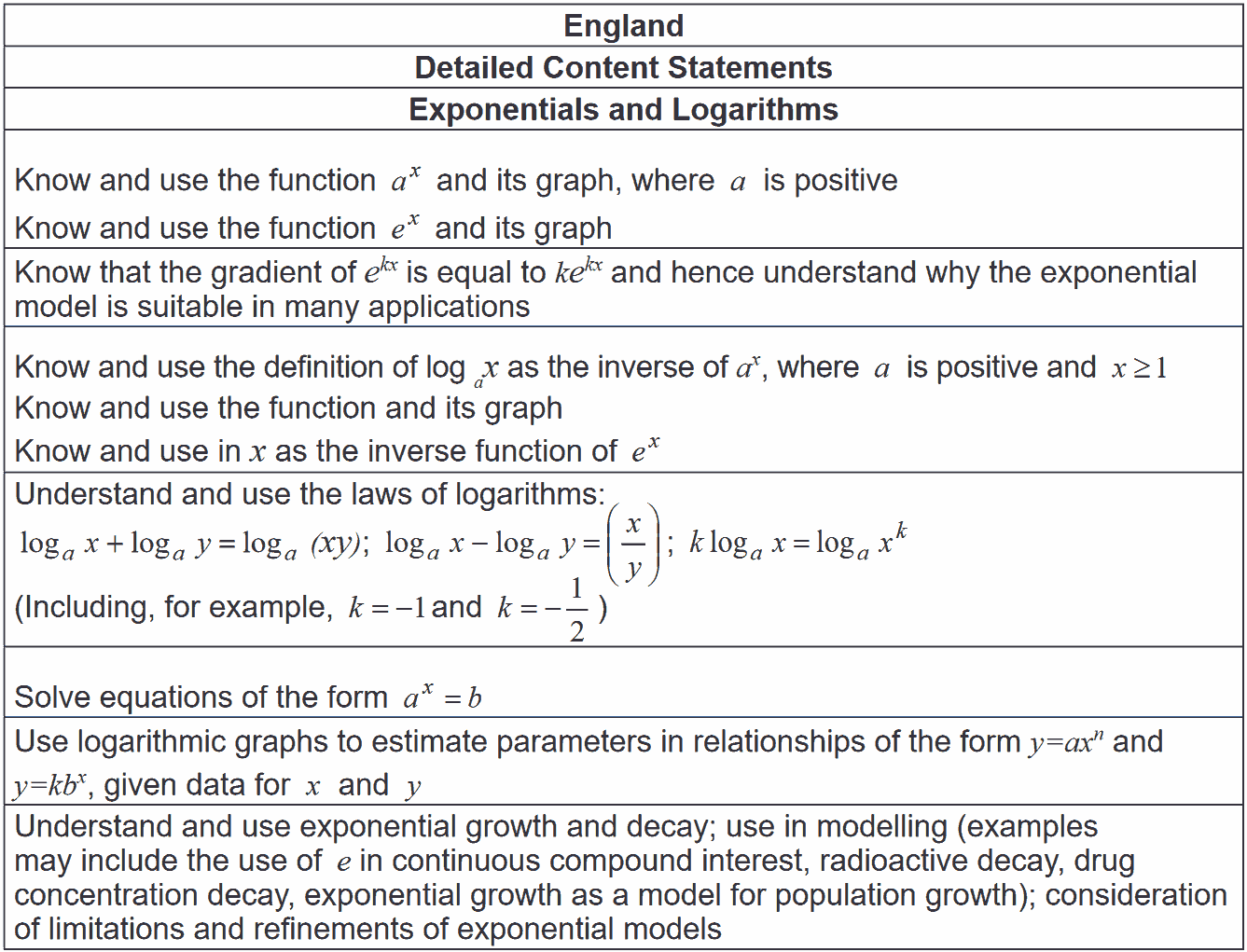
Table 7b
Tables 8a and 8b present the detailed content statements for “Vectors”.
Table 8a
Table 8b
Despite the differences in the style of presentation, what is obvious is that the detailed content statements above are almost identical. However, this is not peculiar to “Exponentials and Logarithms” and “Vectors”. These were just chosen as examples; it is true of all the topics that are taught in both England and Bulgaria. So, what does this say?
Primarily that the differences in the teaching of Mathematics in England and Bulgaria are a function of the differences in the overall curriculum framework; not differences in the Mathematics.
Of course, this is true, Mathematics is Mathematics; what else would one expect? However, maybe if Ellenberg (2014) (see Postscript and Paradox, below) had had more influence and school Mathematics was „simple and profound” rather than being „complex but shallow” students in senior high schools would have to deal with:
– Benacerref’s Dilemma (1973) „what is necessary for mathematical truth makes mathematical knowledge impossible”;
– Pluralism and the foundation of Mathematics, Hellman and Bell (2006); or
– Pluralism: Beyond the One and Only Truth, Horgan (2019).
Then the content statements might well be very different – and legitimately so.
Assessment
There is no Diploma of Secondary Education in England. The students only have their examination results recorded on certificates from the examination boards.
The students can chose at the age of 16 to study Mathematics and two years later they must sit their Advanced Level examinations. This similarly applies to those students who chose to study Higher Mathematics. These students can get the equivalent to two Matura: one in Mathematics and one in Higher Mathematics.
The new Mathematics curriculum was examined for the first time in 2019 and consequently the “Assessment Objectives” have already been published, a student must:
– Use and apply standard techniques;
– Reason, interpret and communicate mathematically; and
– Solve problems within Mathematics and in other contexts.
The examination framework has already been published. There are 3 two-hour examinations:
– Paper 1: Pure Mathematics;
– Paper 2: Pure Mathematics and Statistics; and
– Paper 3: Pure Mathematics and Mechanics.
Similarly, the new Higher Mathematics curriculum was examined for the first time in 2019 with the same overall “Assessment Objectives” and the examination framework has also been published. There are 4 1½ hour examinations:
– Paper 1: Pure Core 1;
– Paper 2: Pure Core 2;
and then 2 from:
– Statistics;
– Mechanics;
– Discrete Mathematics; and
– Additional Pure Mathematics.
Teachers play no part in the summative assessment of the students’ standards of achievement, although they are (of course) involved in the formative assessment of the students during the 2-year course.
In Bulgaria, there is a Diploma in Secondary Education issued by the school. It is based on the results in the Matura examinations and the teachers’ summative assessment of the standards of achievement across the curriculum. The new curriculum will not be examined until 2020, but The Curriculum for Twelfth Grade General Education Mathematics contains clear guidance on the assessment of students’ achievements by their teachers:
Specific Methods and Forms for Assessing Students’ Achievements
Forms of assessment:
Oral examination – assessment of the student's opinion and arguments when solving a particular mathematical problem.
Written examination – assessment of the standards achieved through brief written individual or group tests.
Supervision and classroom work – assessment of the standards achieved at the end of modules and terms
Practical work – homework, project development, etc.
Table 9
Similarly, The Curriculum for Profile Mathematics contains clear guidance on teacher assessment:
Specific Methods and Forms for Assessing Students’ Achievements
Assessment of students' knowledge and skills is in line with the expected results and activities foreseen in the program.
The student needs to be informed in advance of the criteria and the system for assessing his/her achievement.
Table 10
In Bulgaria, all students have to sit a Matura examination in Bulgarian Language and Literature plus one other subject (a very small number take two other subjects). The majority of students in Mathematics profile oriented-classes (be they in Mathematics profile-oriented schools or Mathematics profile-oriented classes in other schools) take the Mathematics Matura as their second subject.
However, the Mathematics Matura must also be available to those students who do not attend a Mathematics profile-oriented school or attend a Mathematics profileoriented school but are not in a Mathematics profile-oriented class. Consequently, much of Profile Mathematics curriculum studied in Klac XII is not examined in the Mathematics Matura.
In Bulgaria there is no Higher Mathematics Matura, as a consequence, there is no external examination of the full range of the Mathematics curriculum for students in Mathematics profile-oriented classes; i.e. there is no external examination of the 405 minutes (9 lessons) per week of Mathematics studied by students in Klac XII in the Mathematics profile-oriented classes.
In England there is no overall Diploma in Secondary Education, but students take external examinations in the full range of the curriculum in all the subjects they have studied:
– 9 written examinations, if the take 3 subjects; and
– up to 13 written examinations, if they take 4 subjects – and one of them is Higher Mathematics.
Teacher assessment plays no part in the summative assessment of the students’ standards of achievement.
Table 11
In Bulgaria, teacher assessment plays a central role in the assessment of students’ standards of achievement across the curriculum. The Mature examinations of 4 hours (but usually, only in two subjects) provide additional information for the Diploma in Secondary Education but do not necessarily cover the whole curriculum in Klas 12.
Table 12
In Bulgaria, all students have to take the Matura examination in Bulgarian Language and Literature plus one other subject. Table 12 illustrates the number of students who took the ten most popular subjects in 2019. As has been indicated, within the current curriculum and assessment frameworks in Bulgaria, there is no space for a Matura in Higher Mathematics. In addition, the very low percentage of students taking the Matura in Mathematics (3.5%) suggests there would be no market for a Matura in Higher Mathematics – unlike England, where 14,527 (2.5%) of the students took A Level Higher Mathematics.
Summary
At the level of individual Topics, where these are covered in both Mathematics (Level II in England) and Profile Mathematics (Level II in Bulgaria) there is, to all intents and purposes, complete congruence between the Detailed Content Statements.
Step up a level, to the range of Topics covered and the pattern is again similar. Of course, some Topics are included in Profile Mathematics in Bulgaria that are not included in Mathematics in England, for example:
– 3-Dimensional Geometry and Geometric Modelling;
others are included in Mathematics in England but not in Profile Mathematics in Bulgaria, for example:
– Integration, Complex Numbers, Polar Co-ordinates, Hyperbolic Functions and Differential Equations.
The overall range of Topics is, however, similar.
At the highest level of generality, there is a similar approach to the Mathematics curriculum. It is specified in terms of General and Specific Objectives and Overarching Themes and these are remarkably similar.
The real differences between the teaching of Mathematics in England and Bulgaria lie not in the Mathematics itself but in the overall curriculum and assessment frameworks within which Mathematics is taught. Students in England have a free choice in the 3 or 4 subjects that they study after the age of 16 - there is no General Mathematics programme. Students in Bulgaria elect or are selected to follow profiles (pathways) at the age of 14 within which there is little subsequent freedom of choice.
In England, there is no Diploma in Secondary Education. At the age of 18, Students take external examinations in the 3 or 4 subjects they chose to study two years earlier. Teachers play no part in the summative assessment of the standards of achievement reached by the students.
The Diploma in Secondary Education is determined by summative assessment undertaken by their teachers across the full range of the curriculum, augmented by the results achieved in the two Matura examinations.
Paradox and postscript
Despite the reform in both countries, little has been done to address the challenge issued by Jordan Ellenberg (2014) in “How not to be wrong. The hidden maths of everyday life”.
Table 13
Simple but shallow
Basic arithmetic facts, like 1 + 2 = 3, are simple and shallow. So are basic identities like sin(2x) = 2 sin x cos x or the quadratic formula: they might be slightly harder to convince yourself of than 1 + 2 = 3, but in the end they don’t have much conceptual weight.
Complicated but shallow – Much of school/college Mathematics
You have the problem of multiplying two ten-digit numbers, or the computation of an intricate definite integral. It’s conceivable you might, for some reason, need to know the answer to such a problem, and it’s undeniable that it would be somewhere between annoying and impossible to work it out by hand; or, it might take some serious schooling even to understand what’s being asked for. But knowing those answers doesn’t really enrich your knowledge about the world.
Simple and profound - This should be the focus for school/college Mathematics
Mathematical ideas that can be engaged with directly and profitably, whether your mathematical training stops at pre-algebra or extends much further. And they are not “mere facts,” like a simple statement of arithmetic— they are principles, whose application extends far beyond the things you’re used to thinking of as mathematical. They are the go-to tools on the utility belt, and used properly they will help you not be wrong.
Complicated and profound
This is where professional mathematicians try to spend most of their time. It’s where the celebrity theorems and conjectures live:
– The Riemann Hypothesis,
– Fermat’s Last Theorem,
– The Poincaré Conjecture,
– P vs. NP,
– Gödel’s Theorem …
Each one of these theorems involves ideas of deep meaning, fundamental importance, mind-blowing beauty, and brutal technicality.
NOTES
1. Mathematics for profile preparation. Ministry of Education and Science.
2. Syllabus for the XI class in force from the academic year 2020-2021. Ministry of Education and Science.
3. Syllabus for the XII class in force from the academic year 2021-2022. Ministry of Education and Science.
REFERENCES
BENACERRAF, P., 1973. Mathematical Truth. The Journal of Philosophy. 70, 661 – 679.
BUDGELL, P. & KUNCHEV, M., 2019. General Theory of Education. Annual Professional Development Meeting for Teachers and Principals. Plovdiv: America for Bulgaria Foundation Department for Education. GCE A Level Subject Content for Mathematics.
DEPARTMENT FOR EDUCATION. GCE A Level Subject Content for Higher Mathematics.
ELLENBERG J., 2014. How not to be wrong. The Hidden maths of everyday life. London: Penguin Press.
HELLMAN G. & BELL J.L., 2006. Pluralism and the foundation of Mathematics. In: Kellert S.H., LONGINO H.E. & WATERS C.K. (ed) Scientific Pluralism, 64 – 79. University of Minneapolis Press.
HORGAN J., 2019. Pluralism: Beyond the One and Only Truth. Scientific American [September 2019].