
Ефективност на обучението
ENHANCING THAI STUDENTS’ THINKING SKILLS ABOUT ENERGY ISSUES: INFLUENCE OF LOCAL VALUES
Резюме. The study aimed to enhance Thai students’ thinking skills on learning about energy related to influence of local value. The participants consisted of 132 Grade 9 students from three different schoolsin Khon Kaen, in North East Thailand. The three participating teachers in these schools had adopted the STS energy unit that developed by researcher. The STS energy unit consists two sub-units:(1) Use energy in Thailand (issue of the increased petrol price); (2) Generation power (issue of the Mae-moh situation). Teachers had attended workshops before and during their adopting the unit. Methodology regarded interpretive paradigm. The students’ thinking skills was investigated through participant observation and informal interview for ten weeks. Their thinking skills were interpreted from the orientation of their posted questions. Based on Zohar &Dori (2003) study, three question orientation attributes including phenomenon or problem description, hazards related to the problem, and treatment or solution were applied for categorized students’ thinking skills. The proposing question in orientation of solution would be viewed as a higher level of understanding the problem than describing it, and finding treatment or solution was more positive and productive than just identifying hazards. Comparing between sub-unit one and two revealed that students across three schools gained more seeking practical solution to a given problem rather than being fixated on requiring about risks. Increasing the hazard and solution oriented questions indicated that the STS energy unit continually supported the development of their thinking skill classification from the sub-unit one to the sub-unit two.
Ключови думи: energy; science technology and society (STS); local value; thinking skills
Introduction
The goal of Thai science education is to assist students to develop thinking skills by considering the relationship between science, technology and society. This goal requires that people have a multidimensional scientific and technological literacy in order to make decisions about issues of science technology and society that affect living across the world (IPST, 2002). To attain the goal of science education, Thai science teachers in general agreed with the need for making science teaching more meaningful by emphasizing student-centеred learning and a concern for life-long learning that should play on the relationship between science, technology and society. The goal of Thai science education was addressed along with these crucial aspects of educational reform. With the attempts for obtaining education reform, one of them involved science teaching and learning that emphasized knowledge rather than a chance for practice in analytical thinking, self-expression and acquiring knowledge by themselves.
The study of energy in Thai schools provides a good opportunity to explore how the reforms to Thai science education are being put into practice. The topic of energy raises many issues for Thailand and addressing those issues requires people who have the skills of thinking, problem-solving, and decision-making; and values that involve dealing with the interactions among science, technology, and society for local issues about energy. To solve these problems, the education reform raised crucial aspects of teaching and learning including a learner-centred approach and life-long learning. This suggests that students should have chance to be in touch and interact with all around them such as other people, nature and technology; and to apply learning methods to their real lives (ONEC, 2002).
The influences of science and technology context suggest that decision-making should be taken into account for energy learning. The decision making requires people who have higher order thinking skills to apply value judgments and other knowledge (Kortland, 1996; Bingle & Gaskell, 1994; Yuenyong & Narjaikaew, 2009). Therefore energy teaching and learning through STS approach requires students’ decision making and higher order thinking skills. Term of higher order thinking skills was clarified concerning with the classical scientific inquiry skills and cognitive activities. Most of the classical scientific inquiry skills, such as formulating hypotheses, planning experiments, or drawing conclusions are also classified as higher order thinking skills. Cognitive activities involves defining the higher order thinking skills beyond the stage of understanding and lower level application according to Bloom’s taxonomy. Based on Bloom’s taxonomy, memorization and recall of information are classified as lower order thinking whereas analyzing, synthesizing, and evaluating are classified as higher order. Additional examples of cognitive activities that are classified as higher order include constructing arguments, asking research questions, making comparisons, solving non-algorithmic complex problems, dealing with controversies, and identifying hidden assumptions (Zohar & Dori, 2003).
This research, therefore, considers embedding cultures into studies of energy including culture of school science, communities, scientific communities, and learners in order to enhance students’ thinking skills.
Entering the relationship between science, technology and society in the energy class would be a possible solution because it supports energy learning by negotiating and disputing scientific knowledge through a socialisation process (Aikenhead, 1994b). The issues about energy such as energy use, energy saving and pollution would enable students to realize the relationship between science, technology and society. The issues require students or citizens to make decisions under a framework of technological and social aspects. The social aspects involve focusing on science and technology with aspects of philosophy, sociology, history, politic, economic, and humanistic. Central to decision-making, technology is a crucial skill for citizens who need to consider multidimensional aspects in their decisions such as any social constraints (Bingle & Gaskell, 1994; Ratcliffe, 1995; Jones, 1997). Broadly speaking; technology is the ideas, designs, systems, volition of scientific applications and other knowledge that is socialised by values and norm before becoming products (de Vries, 1996; Hansen, 1997). The STS Energy teaching and learning, therefore, would allow students to learn energy through decision making for energy issues. According to the different goals of STS there are several ways of attaining STS objectives. The research emphasizes developing the STS energy unit to allow students to learn energy through solving the issues about energy regarding Aikenhead (1994a) sequence for STS science teaching. Teaching and learning is started from society realm and moved to acquiring technology, and science concepts and skills. Finally, students have chance to take action in society. Therefore, the unit should give students chances to identify problems with local interests and the impacts about energy related technological and societal issues. The Unit will, then, allow them to experience citizenship roles as they attempt to resolve issues they have identified. The framework of teaching the STS energy unit, therefore, consists of five stages: (1) identification of social issues; (2) identification of potential solutions; (3) need for knowledge; (4) decision-making; and (5) socialization stage (Yuenyong, 2006).
Identification of social issues stage
This stage is designed to focus student attention and attitudes on learning about energy. The STS instruction has to begin in the realm of society. Instruction will be begun by posing issues related to energy use in society. These questions or problems of social issues need to be solved by citizens. For energy concept, the issue of saving energy and the social problem related generating power should be brought into classroom by various strategies such as informing situation related these issues from posing in newspaper; posing the social questions related these issues for allowing students to participate in public decision-making; seeing social problem by taking field trip.
Identification of potential solutions stage
Students plan to solve the social problem related to energy use. This stage supports students to concern with the technological aspects for find the possible solutions. Technological aspects are skills to support student decision making. Students need to think of what, why, and how ideas, design, systems, volition of application scientific knowledge work for that social problems. Teaching strategies may be used discussion among students’ group, role-play, brain storming, searching information via internet, and discussion with expert (e.g., engineers or scientists).
Need for knowledge stage
This stage involves developing scientific knowledge. Social questions and technological knowledge create the need to know some science content. Energy concept was formulated in many strategies to help students to understand the technology and social issues. The strategies, for examples, include reflection reading document provided by teacher, and lecture. To give feedback students’ understanding about energy concept, the short quiz will be taken after class of this stage.
Decision-making stage
This stage involves student in making a decision on how to use energy knowledge and technology as solution of the social problem. This aspect public rhetoric about energy related technological and societal issues becomes dominated by dichotomies like ‘chances and problem’, ‘advantages and disadvantages’, or uses and abuses’. Student will be given chance to learn to choose between alternatives and in a thoughtful way systematically comparing as many relevant pro’s and con’s as possible. Teaching strategies may be used discussion among students’ group, roleplay, and brain storming.
Socialization stage
Students need to act as people who are a part of society by reporting their proposal for solving problem. They should also validate their solution through social process. Student might exhibit their solution in public by produce a poster, a newspaper article or a plan, social media, or present science project.
Methodology
This research is conducted regarding the interpretive paradigm. Interpretive research seeks to describe and interpret human behaviour based on their natural setting rather than form laws about it (Marriam, 1998; Cohen et al., 2000). Concerning the issue of dependability, therefore, a clear description of how data was obtained and open acknowledge of context should be taken into account. The study enters the relationship between science, technology and society in energy teaching and learning through STS approach. The research was designed to be carried out in the different school contexts in KhonKaen province including schools in the city, a small town, and a rural area. As the process of interpretation, this study aims to interpret students’ thinking skills across three different schools and the implications of these for science teaching and learning in Thailand. The interpretation of data is based on fields work.
Participants
The research was carried with 132 Grade 9 students in the four different schools of KhonKaen province where located in northeastern of Thailand. These schools included school B, C, and D. Each school context is clarified as following.
School B is located in the city, KhonKaen province. The school has a total of 3,000 students in Grades 7 – 12. Kunya is the participating teacher of the school B. She graduated with a Bachelor of Education in home economics. She has 16 years of experiences teaching science. Kunya’ s responsibilities include secretarial and administrative duties as well. Her participating Grade 9 science class includes 49 students, 37 girls and 12 boys, live in the city of KhonKaen and other small towns near the city of KhonKaen. Their parents work for businesses and government offices. The interesting source of energy learning in school B is the Green Classroom that provided and financially supported by the Electricity Generating Authority of Thailand (EGAT).
School C is located in a small town of the KhonKaen province where far approximately 40 km from the city of KhonKaen. The school has a total of 2,500 students in Grades 7 – 12. Ann is the participating teacher of the school C. She graduated with a Bachelor of Education in science for lower secondary school. She has 14 years of experiences teaching science. Ann’ school load include not only science teaching but also working for the school academic affair. Her participating Grade 9 science class includes 47 students, 25 girls and 22 boys, who live in this small town and other villages near this small town. Their parents work in private businesses, government offices, and farms. The interesting source of energy learning in school C is the Green Classroom that provided and financially supported by the Electricity Generating Authority of Thailand (EGAT).
School D is located in a rural area of KhonKaen province where far approximately 60 kilometres from the city of KhonKaen. The school has a total of 600 students in Grades 7 – 12. Pim is the participating teacher of school D. She graduated with a Bachelor of Education in biology. She has 10 years of experiences teaching science. Pim’s school load includes biology and science teaching, head of science department, and head of school academic affair. Her participating Grade 9 science class includes 29 students, 18 girls and 11 boys, who their parents work as laborers in Bangkok and as farmer. The interesting source of energy learning in the school D is the solar power pumped water that was donated by an Australian organization.
Methods of inquiry
The three participating teachers in these schools had adopted the STS energy unit that was developed by the researcher. The STS energy unit consists two subunits:(1) Use energy in Thailand (issue of the increased petrol price); (2) Generation power (issue of the Mae-moh situation). Example of unit outlined as showing in the Table 1. Participating Teachers had attended the workshops before and during their adopting the unit. Students’ posing questions in the STS energy unit could be viewed as their thinking skills classifications. The students’ thinking skills was interpreted from the orientation of their posted questions.
Zohar & Dori (2003) suggested three question orientation attributes including phenomenon or problem description, hazards related to the problem, and treatment or solution. The proposing question in orientation of solution would be viewed as a higher level of understanding the problem than describing it, and finding treatment or solution was more positive and productive than just identifying hazards.
Examples of posed questions in the orientation of phenomenon include “What is the fossil?”, “What is megawatt?”, and “What are the effects of the Mae-moh power plant?” Orientation of identifying hazards could be seen, for examples, including “What are factors run the increased petrol price?”, “If the petroleum runs out, what can we do?”, “How long before will coal run out?”, “How can air pollution occur at the Mae-moh?”, and so on. Examples of posed question orientation of finding treatments or solutions include “What are any strategies to decrease the price of petrol?”, “Are the vegetable oil used in a car?”, “What can we do to reduce the use of coal?”, and “Why doesn’t government construct the Nuclear power plant?”
Table 1. Example of outline of the STS energy lesson plan
Findings
The STS energy unit gave students chance to make skeptical ideas to the energy issues related technological and societal aspects. Students’ posing questions could be viewed their thinking skills classifications. The number of posed questions in the Identification of social issues stage was counted and categorized each question by its orientation. Students’ thinking skills in school B, C, and D could be reported as below.
School B students’ thinking skills
Students’ posing questions showed their thinking skills classifications. The number of posed questions in the Identification of social issues stage was counted and categorized each question by its orientation. The three question orientation attributes include phenomenon or problem description, hazards related to the problem, and treatment or solution. The proposing question in orientation of solution would be viewed as a higher level of understanding the problem than describing it, and finding treatment or solution was more positive and productive than just identifying hazards.
In sub-unit one, school B students developed their understanding the issues through group discussion. Then they posed their question to the issue of increased petrol price. Interestingly, all groups of students posed a number of oriented questions of finding treatments or solutions. There were not many the oriented questions of phenomenon and identifying hazards as showed in the Fig. 1. Examples of posed questions in the orientation of phenomenon include: what is the fossil; what is the difference of benzene 91 and 95?
Examples of posed question orientation of identifying hazards in sub-unit one include: what are factors run the increased petrol price; if the petroleum runs out, what can we do; if the government did not fix the petrol price, how will the economic be ruined now.
Examples of posed question orientation of finding treatments or solutions in sub-unit one include: what are any strategies to decrease the price of petrol; what don’t we use other energy sources e.g., wind and water power to substitute petrol; if the petrol price keeps growing, shall we use some renewable energy sources; what are the energy sources that should be substituted the petrol; are the vegetable oil used in a car.
In sub-unit two, again, school B students posed a number of questions of solution orientation. There were not many the oriented questions of phenomenon and identifying hazards as showed in the Fig. 1. These assumed that they held a high level of thinking skills classifications. The examples of posed questions in the orientation of phenomenon include: what is megawatt; what are the effects of the Mae moh power plant.
Examples of posed question orientation of identifying hazards in sub-unit two include:How long before will coal run out; How can air pollution occur at the Maemoh; why did air pollution surrounding the Mae moh power plant turn to be serious in the winter.
Examples of posed question orientation of finding treatments or solutions in sub-unit twoinclude:What can we do to reduce the use of coal; Why don’t they use other energy sources; why doesn’t government construct the Nuclear power plant; what are the strategies that should be used to eliminate the sulfur dioxide; what should we do next to solve the problem of the Mae-moh environment damages.
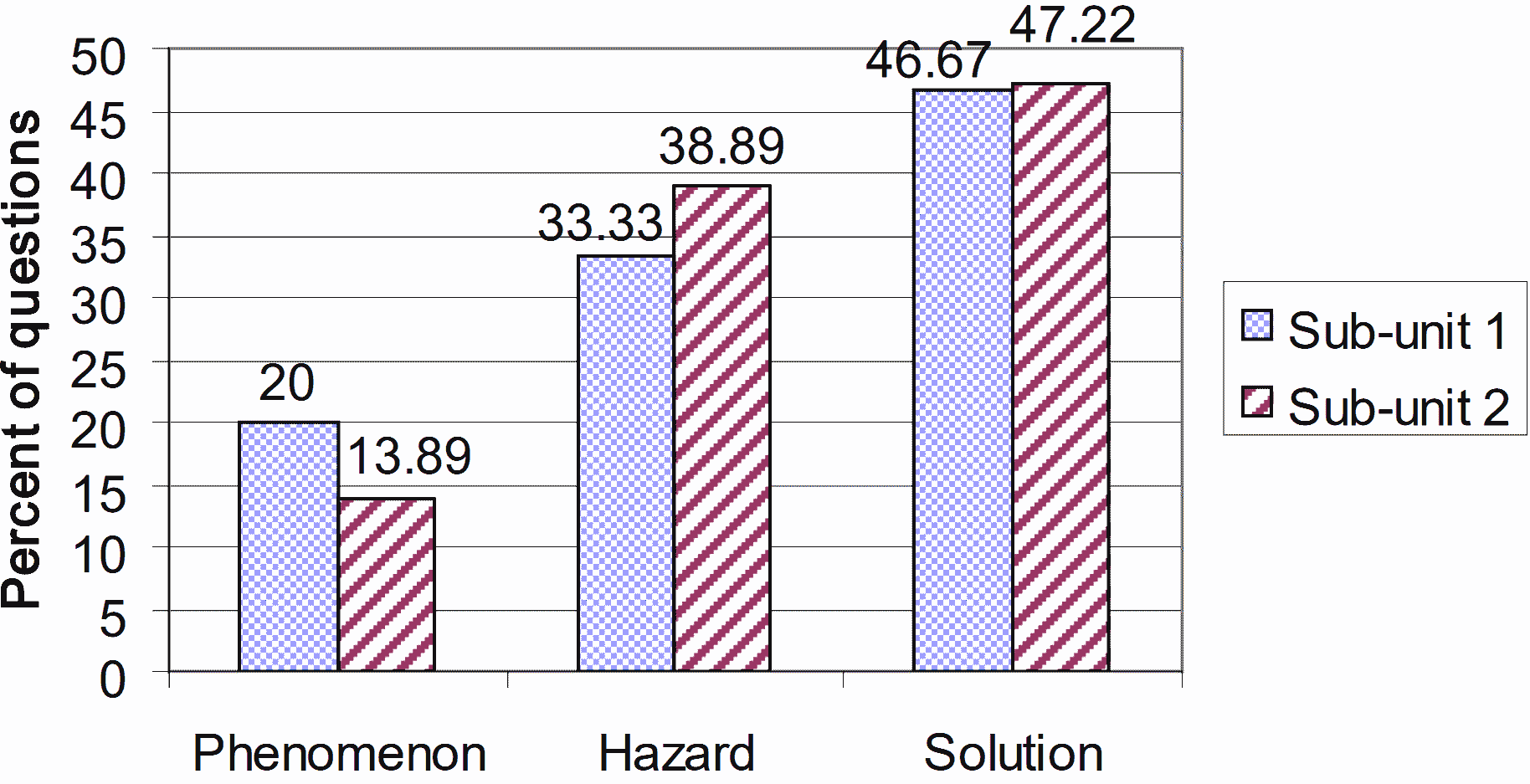
Fig. 1. Trends in the School B students’ question orientation of the sub-unit 1 and 2
According to Fig.1, the STS energy unit exposed students to controversial energy issues that allowed students to express their ability of thinking skills classifications. Approximately fifty percent of school B students’ posing the solution oriented questions was found both in sub-unit one and two. The percentages of identifying hazards oriented questions increased from 33.33% in sub-unit one to 38.89% in sub-unit two. The percentages of phenomenon oriented question decreased from 20.00% in sub-unit one to 13.89% in sub-unit two. This suggested that the STS energy unit continually supported the development of school B students’ thinking skill classification from sub-unit one to sub-unit two.
School C students’ thinking skills
Students’ posing questions could analyze their thinking skills classifications. The number of posed questions in the Identification of social issues stage was counted and categorized each question by its orientation. The three question orientation attributes include phenomenon or problem description, hazards related to the problem, and treatment or solution. The proposing question in orientation of solution would be regarded as a higher level of understanding the problem than describing it, and finding treatment or solution was more positive and productive than just identifying hazards.
School C students were, the first sub-unit, a little confused why they needed to pose questions. They seemed to be worried the answer of those questions. They had to know what they asked. They, therefore, normally posed questions that were provided information in worksheets. Posed questions in sub-unit one were categorized into the orientation of phenomenon or problem description, for examples: what is fossil; how many bath has government paid to fix price of petrol below 20 bath per liter; what year did we encounter with the situation of high petrol price.
The examples of posed question orientation of identifying hazards in subunit one include: when will the price of petrol be higher than 20 bath per liter; what happen next, if the government stops paying money to fix oil price.
The examples of posed question orientation of finding treatments or solutions in sub-unit one include: what can we do to decrease energy use; what should we do when the oil run out.
Starting sub-unit 2, students felt free to pose questions. It was observed that they tried to pose more question. They shared their skeptical ideas of the Maemoh situation in group. Their questions posed in sub-unit two were categorized into the orientation of phenomenon, for example: what province was the Maemoh power plant located; how many watts does one megawatt equal; what is the chemical formula of sulfur dioxide; what fuel was used in Mae-moh; what happened in the year 1987 and 1997.
The examples of posed question orientation of identifying hazards in subunit two include: how did emitted sulfur dioxide affect the environment; what are kinds of diseases that are caused by the sulfur dioxide; how can air pollution occur at the Mae-moh; what are disadvantage consequences of closing down the Mae-moh power plant.
The examples of posed question orientation of finding treatments or solutions in sub-unit two include: what should be the fuel of the Mae-moh power plant, if the lignite was used; if you were in this situation, what would you do; what should be the method of emitting gas from the power plant for reducing environment damages as much as we could; what should we do next to solve the problem of the Mae-moh environment damages.
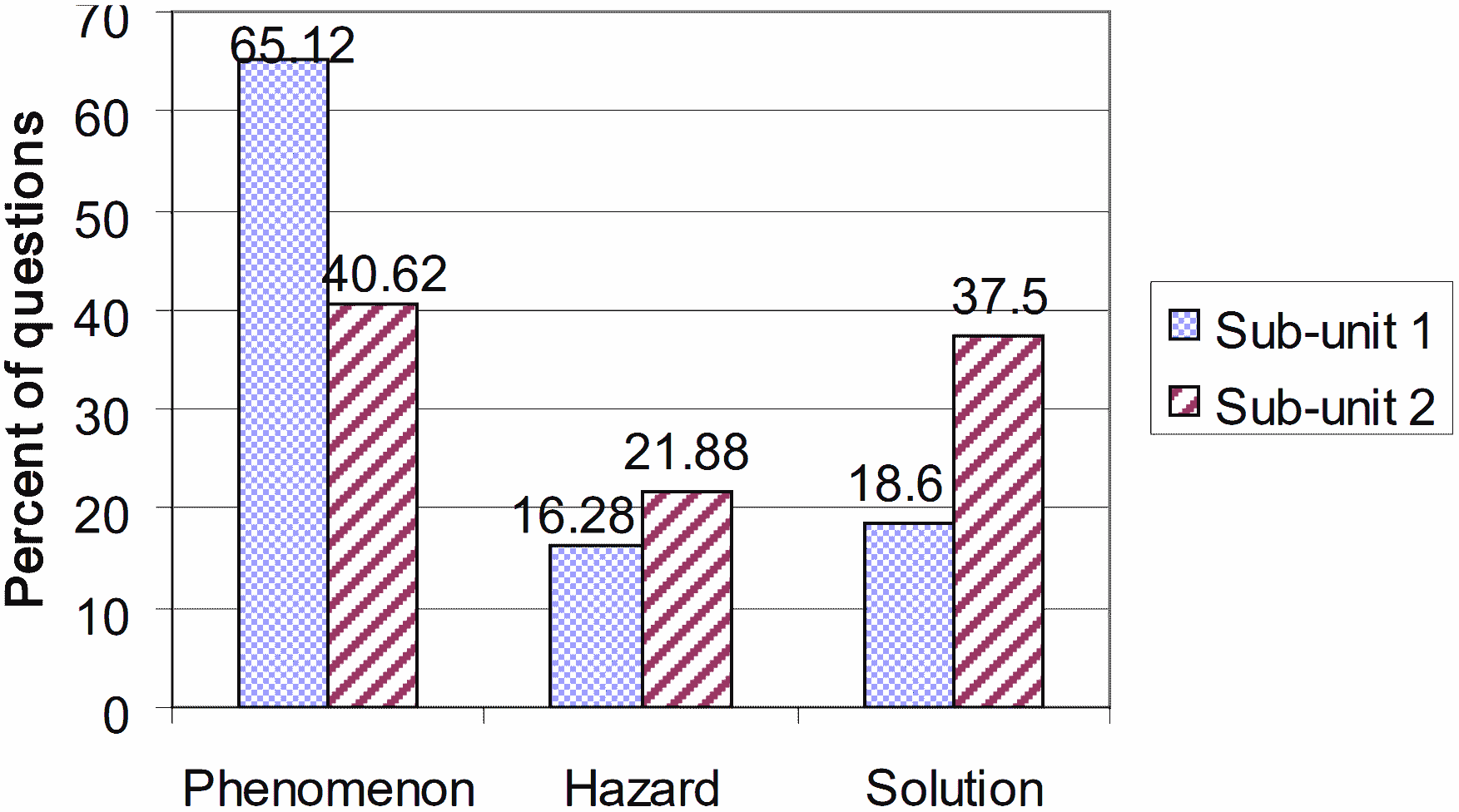
Fig. 2. Trends in the school C students’ question orientation of sub-unit 1 and 2
Compare trend of students questions’ orientation between sub-unit 1 and 2. According to Fig. 2, the percentage of phenomenon oriented question decreased from 65.12% in sub-unit 1 to 40.62% in sub-unit 2. The percentages of solution and hazard oriented questions increased from 18.6% in sub-unit 1 to 37.5% in sub-unit 2, and 16.28% in sub-unit 1 to 21.88% in sub-unit 2; respectively. This indicated that students expanded higher level of thinking skills. Huge increase in solution oriented questions indicated that students aware of seeking practical solution to a given problem rather than being fixated on requiring about risks. This suggested that considering the alternative solution in sub-unit one stimulated students to develop their thinking skill classifications in the beginning of sub-unit two.However, the phenomenon oriented questions still remained the highest number of questions. This might root from students posing questions of which they had already known the detailed information answer. They seemed to be worried about the answer of their questions.
School D students’ thinking skills
Students’ posing questions could analyze their thinking skills classifications. The number of posed questions in the Identification of social issues stage was counted and categorized each question by its orientation. The three question orientation attributes include phenomenon or problem description, hazards related to the problem, and treatment or solution. The proposing question in orientation of solution would be considered as a higher level of understanding the problem than describing it, and finding treatment or solution was more positive and productive than just identifying hazards.
In sub-unit one, school D students developed their understanding of issues through group discussion. Then they posed their question to the issue of the increased petrol price. It seemed that they tried to make the questions from the provided information rather than from their skeptical views. This resulted that there were a number of posed questions in the orientation of the phenomenon or problem description but there were few posed questions in the orientation of the identifying hazards, and the finding treatments or solutions as showed in the Fig.3. The examples of posed questions in the orientation of phenomenon include: how much has the government paid for fixing the petrol price since the 10th January until 17th June 2004; what does the word of the fixing the petrol price mean; how does the petrol involve the oil; where oil discovered first.
The examples of posed question orientation of identifying hazards in sub-unit one include: if the government does not longer fix the petrol price, how will Thailand economic be; the increased petrol price affects the goods price and cost of electricity - so, what is next; if the government does not longer fix the petrol price, what will be happened.
The examples of posed question orientation of finding treatments or solutions in sub-unit one include: if oil runs out, what energy sources should be substituted.
In sub-unit two, Teacher Pim reflected students to make questions requiring analysis or applications. She reminded her students to decrease the questions that had explicitly known answers. This fostered the school D students to make a number of the questions in the orientation of the hazards and the solutions as shown in Fig.3. School D students posed the question orientation of phenomenon in sub-unit two, for example: what are the causes of the 1st – 3rd the Mae-moh power plant generator stopped running; how many megawatts does a generator produce; how many years have the Mae-moh power plant run.
The examples of posed question orientation of identifying hazards in sub-unit two include: what are the environment effects of sulfur dioxide; why does the Maemoh power plant hurt a number of people surrounding the Mae-moh district; maemoh power plant released sulfur dioxide polluting the air; what else pollutes the air; if we have no longer the Mae-moh power plant, how will we have enough electric energy use.
Examples of posed question orientation of finding treatments or solutions in sub-unit two include: how can the government solve the problem of the Mae-moh situation; if the coal runs out, what energy sources should be used; what other energy sources should be used in the Mae-moh power plant; how will we protect and solve the problem of air pollution; what are the strategies that should be used to eliminate sulfur dioxide.
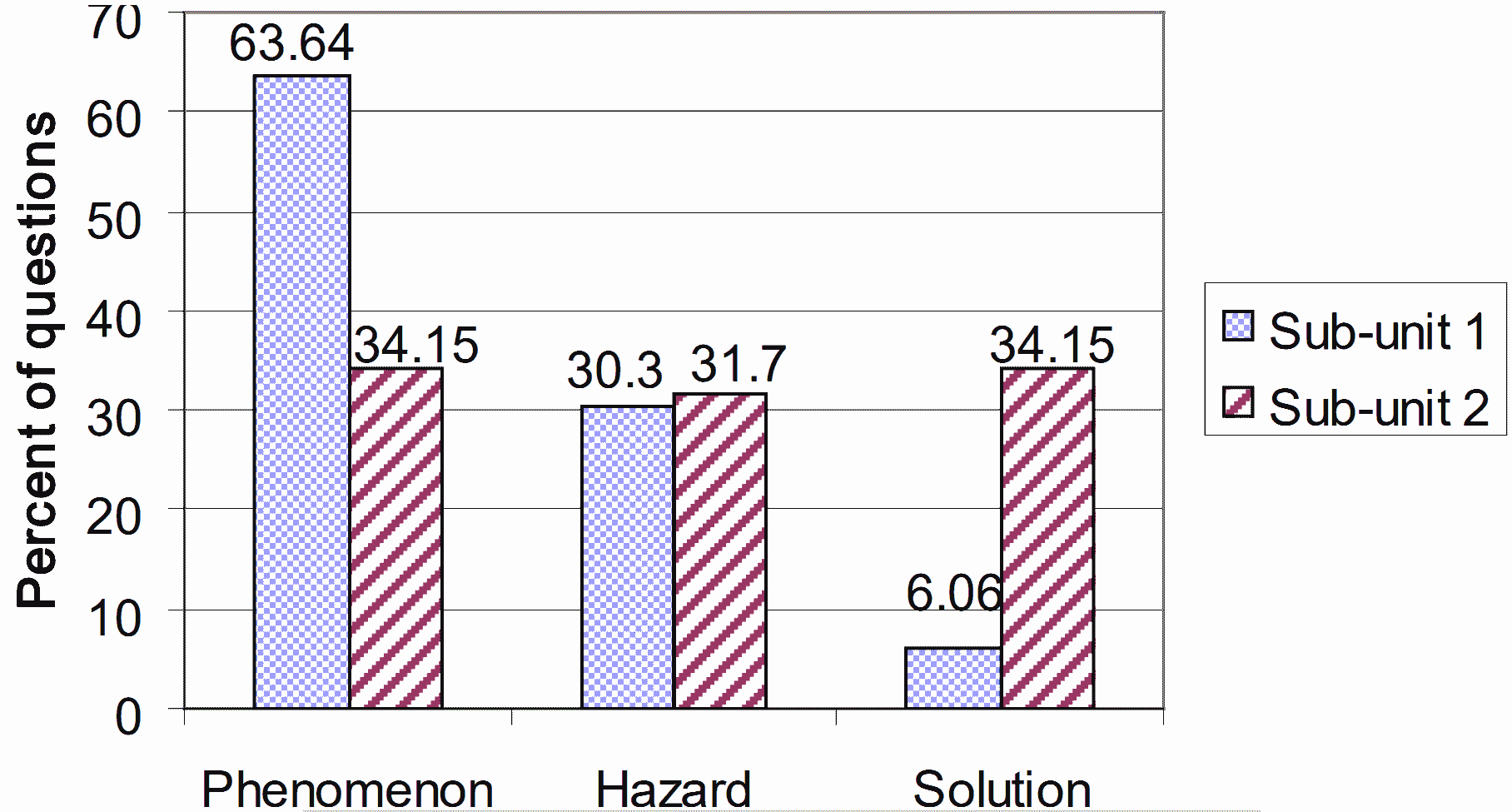
Fig. 3. Trends in the school D students’ question orientation of the Sub-unit 1 and 2
According to the Fig. 3, it assumed that the STS energy unit exposed students to controversial energy issues that advocated students to develop their ability of thinking skills classifications. The percentages of phenomenon oriented question decreased from 63.64% in sub-unit one to 34.15% in sub-unit two. The percentages of hazard oriented questions stay quite the same. The percentages of solution oriented questions increased from 6.06% in sub-unit one to 34.15% in sub-unit two. A Huge increase of the solution oriented questions indicated that school D students expanded higher level of thinking skills. They gained more seeking practical solution to a given problem rather than being fixated on requiring about risks. This suggested that the STS energy unit continually supported the development of school D students’ thinking skill classification from sub-unit one to sub-unit two.
Conclusion
This study indicated the strengths of energy teaching and learning through the STS approach. The STS energy teaching and learning not only enhanced students’ understanding of energy concepts but also gave students chances to develop their thinking skills.Comparing between sub-unit one and two revealed that students across three schools gained more seeking practical solution to a given problem rather than being fixated on requiring about risks (Figs. 1-3). Increasing the hazard and solution oriented questions indicated that the STS energy unit continually supported the development of their thinking skill classification from the sub-unit one to the sub-unit two. Interestingly, there was a huge of an increase solution oriented question for school C and D students. This assumed that they expanded a higher level of thinking skills classification. This reflected also that number of them had a lower level of thinking skills before the STS energy unit. Therefore, it assumes that the STS unit could enhance students to develop their thinking skills although they came from different background and prior knowledge.
Acknowledgements: This research was financially supported by The Institute for Promotion Science and Technology Teaching (IPST). And, this work was supported by KhonKaen University through the Cluster of Science and Computer Education Research.
REFERENCES
Aikenhead, G.S. (1994a). What is STS science teaching (pp. 47 – 59). In: Solomon, J. &Aikenhead, G.S. (Eds.). STS education: international perspective on reform. New York: Teachers College Press.
Aikenhead, G.S. (1994b). Consequences to learning science through STS: a research perspective (pp. 169 – 186). In: Solomon, J. &Aikenhead, G.S. (Eds.). STS education: international perspective on reform. New York: Teachers College Press.
Bingle, W.H. & Gaskell, P.J. (1994). Scientific literacy for decision making and the social construction of knowledge. Sci. Educ., 78, 185 – 201.
Cohen, L., Manion, L. & Morrison, K. (2000). Research methods in education. London: Routledge.
De Vires, M.J. (1996). Technology education: beyond the ‘technology is applied science’ paradigm. Int. J. Techn. Educ. , 8, art. 1.
Hansen, K.-H.(1997). Science and technology as social relations towards a philosophy of technology for liberal education. Int. J. Technology & Design Educ. , 7, 49 – 63.
IPST [Institute for the Promotion of Teaching Science and Technology]. (2002). The manual of content of science learning. Bangkok: Curusaphaladphoa.
Jones, A. (1997). Recent research in learning technological concepts and processes. Int. J. Technology & Design Educ., 7, 83 – 96.
Kortland, K. (1996). An STS case study about students’ decision making on the waste issue. Sci. Educ., 80, 673 – 689.
Merriam, S.B. (1988). Case study research in education: a qualitative approach. San Francisco: Jossey-Bass.
ONEC [Office of the National Education Commission]. (2000). Learning reform: alearner-centredapproach. Bangkok:WattanaPanit.
Ratcliffe, M. (1995). Adolescent decision-making, by individuals and groups, about science-related societal issues (pp. 126 – 140). In :Westford, G., Osborne, J., & Scott, P. (Eds.). Research in science education in Europe: current issues and themes. London: Falmer Press.
Yuenyong, C. (2006). Teaching and learning about energy: using STS approach: DSc thesis. Bangkok:Kasetsart University.
Yuenyong, C. &Narjaikaew, P. (2009). Scientific literacy and Thailand science education. Int. J. Environ.& Sci. Educ.,4. 335 – 349.
Zohar, A.&Dori, Y.J. (2003). Higher order thinking skills and low-achieving students: are they mutually exclusive. J. Learn. Sci.,12, 145 – 181.