
Нови подходи
A NEW EASY METHOD FOR ASSIGNING ABSOLUTE CONFIGURATION WITHOUT THE USE OF MODELS
Резюме. Four rules of thumb were developed to find the absolute configuration of a molecule without using any stereo model or hand analogies. This method will be a boon for students who are unable to visualize a three-dimensional structure or any model. A maximum thirty seconds is required to assign absolute configuration by using this method.
Ключови думи: chirality; absolute configuration; stereo model
Introduction
To have a good comprehension of medicinal chemistry, a knowledge of stereochemistry is essential as there is a deep correlation between the biological activity of an organic molecule with its three dimensional shape. Absolute configuration is one of the more complicated topics to understand especially for undergraduate students. Most of organic chemistry textbooks including those at college and high school level are written using 3D models. In the classroom, models were used by all college chemistry professors and high school chemistry teachers to clarify the concept of absolute configuration.To be a master in this topic we must develop “stereoperception” or three dimensional “vision” (Mattern, 1985; Huheey 1986). In my teaching experience I found that most of the students do not have a “stereoperspective” mind. Mostly, we view the chiral molecule as two-dimensional structure in the text books, on teaching boards and in our exam papers. For the latter, we are not allowed to carry the molecular model kit to solve the problem. In this regard, it will be a successful method if we teach a method/rule or trick for two-dimensional view without using any model. This article reports a simple trick for assigning absolute configuration to a molecule without using any 3D models and it will be helpful to those students who are unable to visualize the three dimensional structure of any chiral molecule.
Hypothesis
Consider some of the structural drawings of (S)-2-chlorobutane given in Fig.1. These are simply different graphical representations of the same molecule.
Figure 1. Six ways of depicting (S)-2-chlorobutane
Rule of thumb 1: View the two-dimensional structure of a chiral molecule in such a way that the hashed and wedged bonds move away from the viewer. For example, viewer can look at the structure (A-C) given below, the pointed arrow indicates the direction of view (Fig. 2).
Figure 2. Angle of view
There are two pairs of hashed and wedged bonds in the structures D to F. The viewer can select any one of the pairs among them and view the molecule in such a way that the hashed and wedged bonds move away from them. For example, the viewer can pick any angle of views (D-1 to D-4) for the structure D (Fig. 3) and follow the rule of thumb 1 to get same absolute configuration for any pairs of hashed and wedged bonds.
Figure 3. Various angle of view for the structure D
Rule of thumb 2: Assigning the atoms or groups in four corners of “+” symbol.
First step: Fix the atom or group connected by wedge bond on top of the vertical line.
Second step: Fix the atom or group connected by hashed bond on bottom of the vertical line.
Third step: From the point of looking view, pick the group which is on the lefthand side of the viewer and fix it on left side of the horizontal line.
Fourth step: Similarly, pick the group or atom which is on the right-hand side of the viewer and place it on right side of the horizontal line.
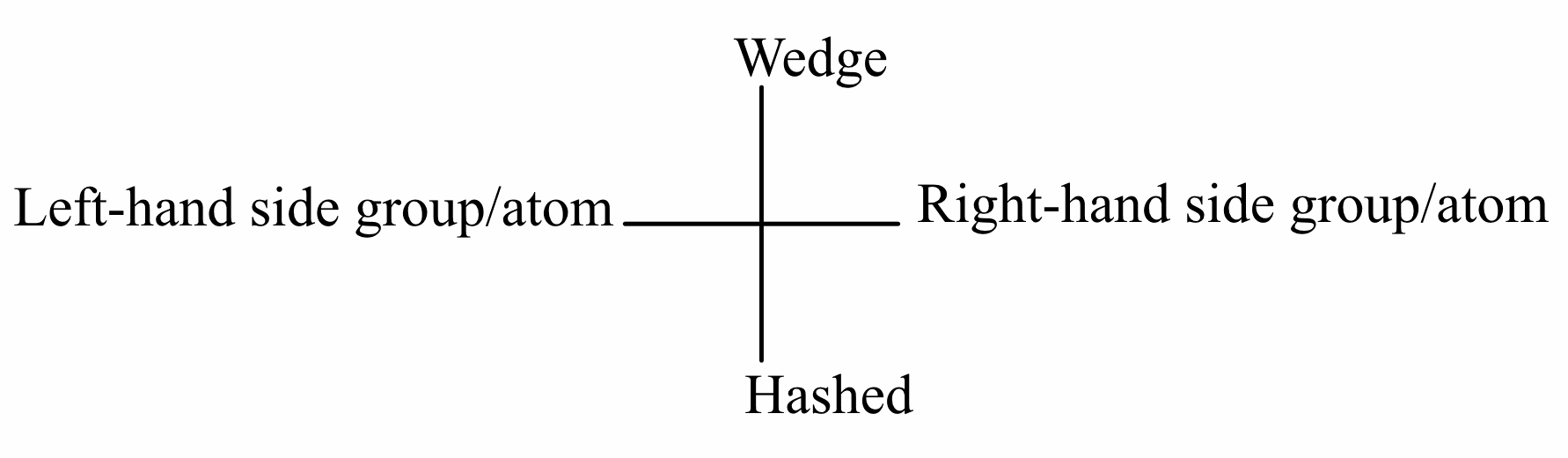
Rule of thumb3: Assigning the priority of atom or group by sequence rule. Connect from highest to lowest priority to observe R (rectus) or S (sinister) configuration.
Rule of thumb 4: Finally, the above configuration could be confirmed by looking where the lowest priority group or atom lies on (i.e., either vertical or horizontal line): (i) The configuration remains same as we observed in rule of thumb 3 if we find the lowest priority group lies on either top or bottom of the vertical line; (ii) The configuration will be reversed if we find the lowest priority or group lies on either right or left side of the horizontal line. (i.e. R to S or vice versa). This can be obtained by double swaps to get the lowest priority into top or bottom of the vertical line.
Now, apply the above rules of thumb to assign absolute configuration for the structure A.
Rule of thumb 1: View the molecule as mentioned below. The angle of view shows that both hashed and wedged bonds move away from the viewer (Fig. 4).
Figure 4. Angle of view for the structure A
Rule of thumb 2: Next, position the atom or groups into four different corners (Fig.
Figure 5. Angle of view and alignment of groups
Rule of thumb 3:According to sequence rule, chlorine atom gets first priority, ethyl group gets second priority, the methyl group gets third priority and finally the hydrogen atom (Fig. 6). It shows R configuration.
Figure 6. Prioritize the groups
Rule of thumb 4: Finally, the lowest priority position has to confirm whether it lies on the vertical or the horizontal line. Here, the lowest priority lies on the horizontal line so the above configuration should be reversed from R to S by double swap as mentioned earlier in the rule of thumb 4 (Fig. 7).
Figure 7. Swapping the groups
After the double swap, the lowest priority lies on the vertical line hence we can finalize the absolute configuration. Finally, the absolute configuration of the structure A is found to be S (sinister configuration).
Now we discuss another example, structure D which contains two pairs of hashed and wedged bonds. It can be viewed in four different angles as described above. Here, for the structure D at least two different angles of view (D-1, D-2) to prove the rule of thumb1is working flawlessly (Fig. 8).
Figure 8. Various angle of views for the structure D and its absolute configuration
Conclusion
The above four rules of thumb were applied around different chiral centers including ring structures to validate our hypothesis and prove it is successful. In conclusion, the method described is a fast, comprehensive and reliable method for students to use whenever they need to visualize a three-dimensional structure or any model.
Acknowledgement. The author would like to thank Prof. V. K. Kapoor for constructive criticism to improve the manuscript.
REFERENCES
Huheey, J.E. (1986). A novel method for assigning R, S labels to enantiomers. J. Chem. Educ.,63, 598.
Mattern, D.L. (1985). Fingertip assignment of absolute configuration. J. Chem. Educ., 62, 191.